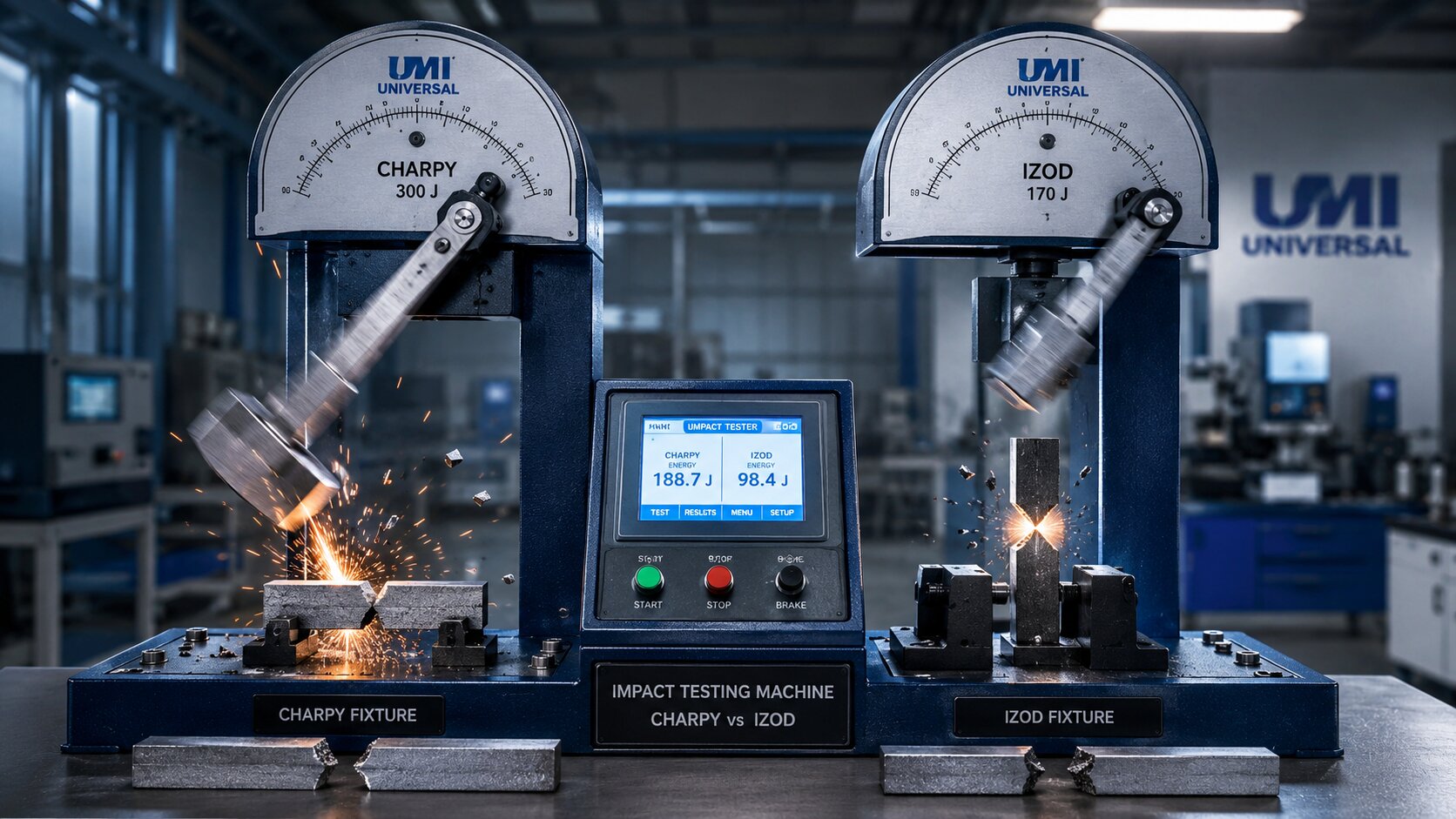
Impact Testing Machine: Charpy vs Izod — Working Principle, Types, Applications, Standards & How to Choose the Right Impact Tester
When a steel structure collapses, an aircraft component fractures under vibration, or a pipeline fails in winter — the root cause is often not inadequate tensile strength but inadequate impact toughness. A material may pass every static tensile or hardness test and still shatter under a sudden dynamic load, especially at low temperatures. This is why the Impact Testing Machine — specifically the Charpy and Izod pendulum impact testers — is one of the most critical instruments in any material testing laboratory.
Whether you are evaluating structural steel for a bridge project, qualifying a grade of TMT rebar, testing the cold-weather performance of a pressure vessel, or selecting the right polymer for an automotive bumper — the impact test gives you data that no other test method can provide. This complete guide covers everything: how the Charpy and Izod tests work, the key differences between them, what the results mean, applicable Indian and international standards, and how to choose the right impact testing machine for your lab.
UMI Universal Motion manufactures a complete range of material testing machines from our Pimpri-Chinchwad, Pune facility, including pendulum impact testers compliant with IS 1499, IS 1598, ASTM E23, and ISO 148. This guide draws on 23+ years of manufacturing and application experience.
| 300 J Standard Charpy capacity (metals) | 170 J Standard Izod capacity (metals) | IS 1499 Indian std — Charpy impact test | IS 1598 Indian std — Izod impact test |
1. What Is an Impact Testing Machine?
An impact testing machine is a precision instrument that measures the energy absorbed by a notched specimen when it is fractured by a single high-velocity blow from a pendulum hammer. This energy — measured in Joules (J) — quantifies a material’s impact toughness: its ability to absorb energy and resist fracture under sudden dynamic loading.
Impact toughness is fundamentally different from tensile strength or hardness. A high-tensile-strength steel may be brittle and absorb very little energy before fracturing under impact — while a lower-strength steel may absorb several times more energy by deforming plastically before breaking. This is why impact testing is a separate, mandatory test for structural steels, pressure vessel materials, pipelines, fasteners, and any component exposed to dynamic loads, vibration, or low temperatures.
The two dominant methods of pendulum impact testing are the Charpy test (IS 1499, ASTM E23, ISO 148) and the Izod test (IS 1598, ASTM E23, ISO 180). Both use the same basic principle — a swinging pendulum fracturing a notched specimen — but differ in how the specimen is supported and struck.
2. Working Principle of a Pendulum Impact Tester
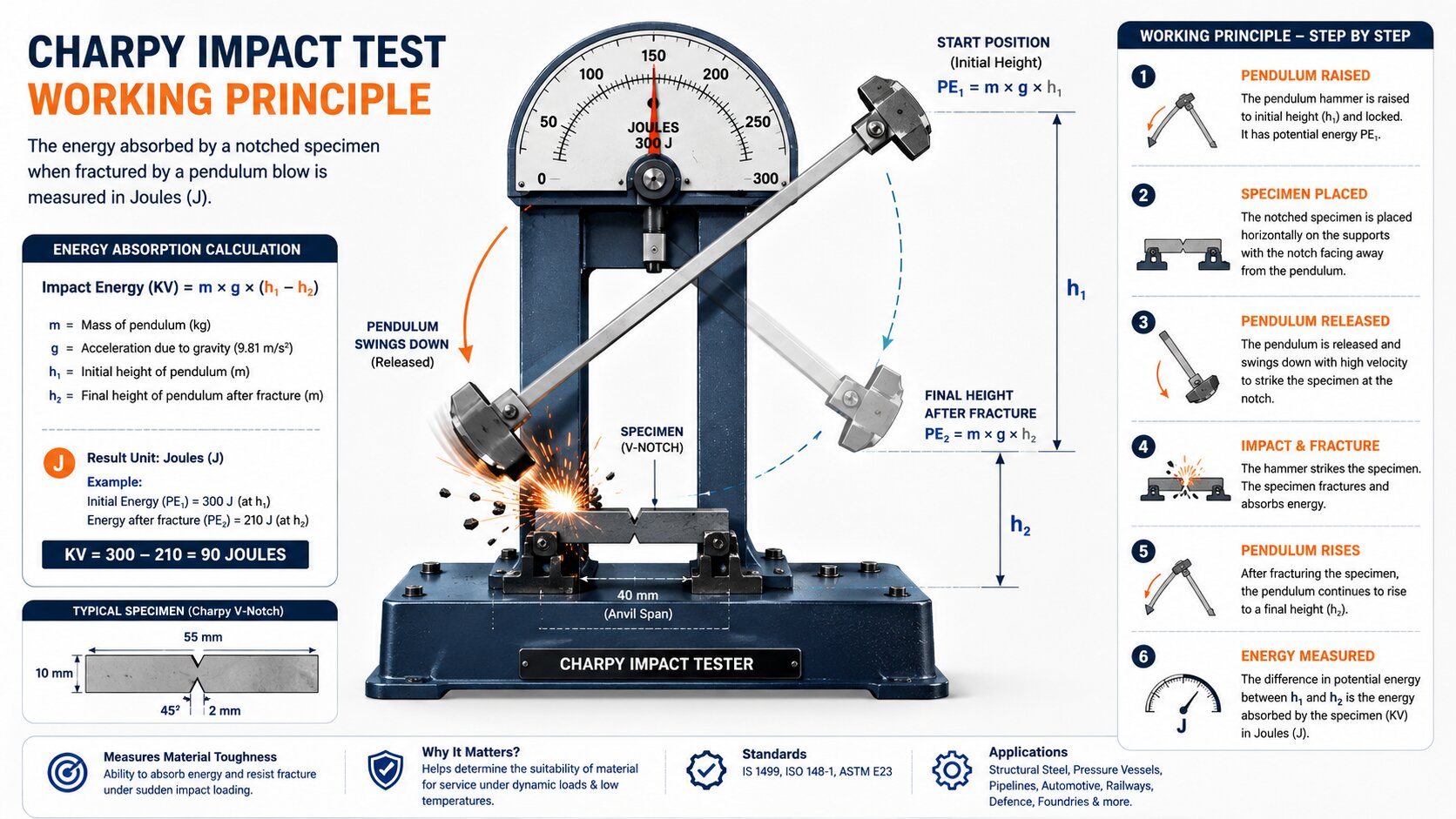
The operating principle of both Charpy and Izod impact testers is based on the conservation of energy. Here is the step-by-step sequence:
Step 1 — Pendulum Raised to Starting Position
The pendulum hammer (a heavy mass at the end of a rigid arm) is raised to a fixed initial height (h₁) and locked in the starting position. At this height the pendulum has a known potential energy: PE₁ = m × g × h₁. For a standard Charpy machine, the pendulum is released from a drop angle of 140° giving an initial energy of 300 Joules. For Izod, the drop angle is 90°, giving 170 Joules initial energy.
Step 2 — Specimen Preparation and Placement
The test specimen (10×10×55 mm for standard Charpy; 10×10×75 mm for standard Izod) is machined with a precise V-notch or U-notch at its centre. The notch is the controlled weak point where fracture is intended to initiate. The specimen is placed in the correct position — horizontally on the support anvils for Charpy, or vertically clamped as a cantilever for Izod — with the notch facing away from the pendulum strike direction.
Step 3 — Pendulum Released — Impact Occurs
The pendulum is released. It swings down freely, reaches its maximum velocity at the bottom of the arc, and strikes the specimen at the notch location. The impact is instantaneous — the entire fracture occurs in milliseconds. The specimen fractures (or bends plastically, if the material is very tough).
Step 4 — Pendulum Swings Through — Rise Height Measured
After fracturing the specimen, the pendulum continues swinging upward to a new height (h₂). Because energy was absorbed by breaking the specimen, h₂ is less than h₁. The energy absorbed by the specimen (impact energy, KV or KU for Charpy; KI for Izod) is calculated as:
| Impact Energy Formula Energy Absorbed (KV or KI) = m × g × h₁ − m × g × h₂ = m × g × (h₁ − h₂) Where: m = mass of pendulum (kg) | g = 9.81 m/s² | h₁ = initial height | h₂ = final height after fracture Result unit: Joules (J). Example: Initial PE = 300 J. Rise after fracture = 210 J absorbed by specimen → Impact Energy = 300 − 210 = 90 J (but machine directly reads 90 J on the pointer scale). |
Step 5 — Reading the Result
On analogue machines, a drag pointer records the maximum rise position on the calibrated dial scale, and the operator reads the absorbed energy directly in Joules. On digital and computerized machines, a high-resolution encoder measures the swing angle electronically and calculates the absorbed energy automatically, displaying it on a digital screen and printing or storing the result.
3. Charpy vs Izod Impact Test — Full Comparison
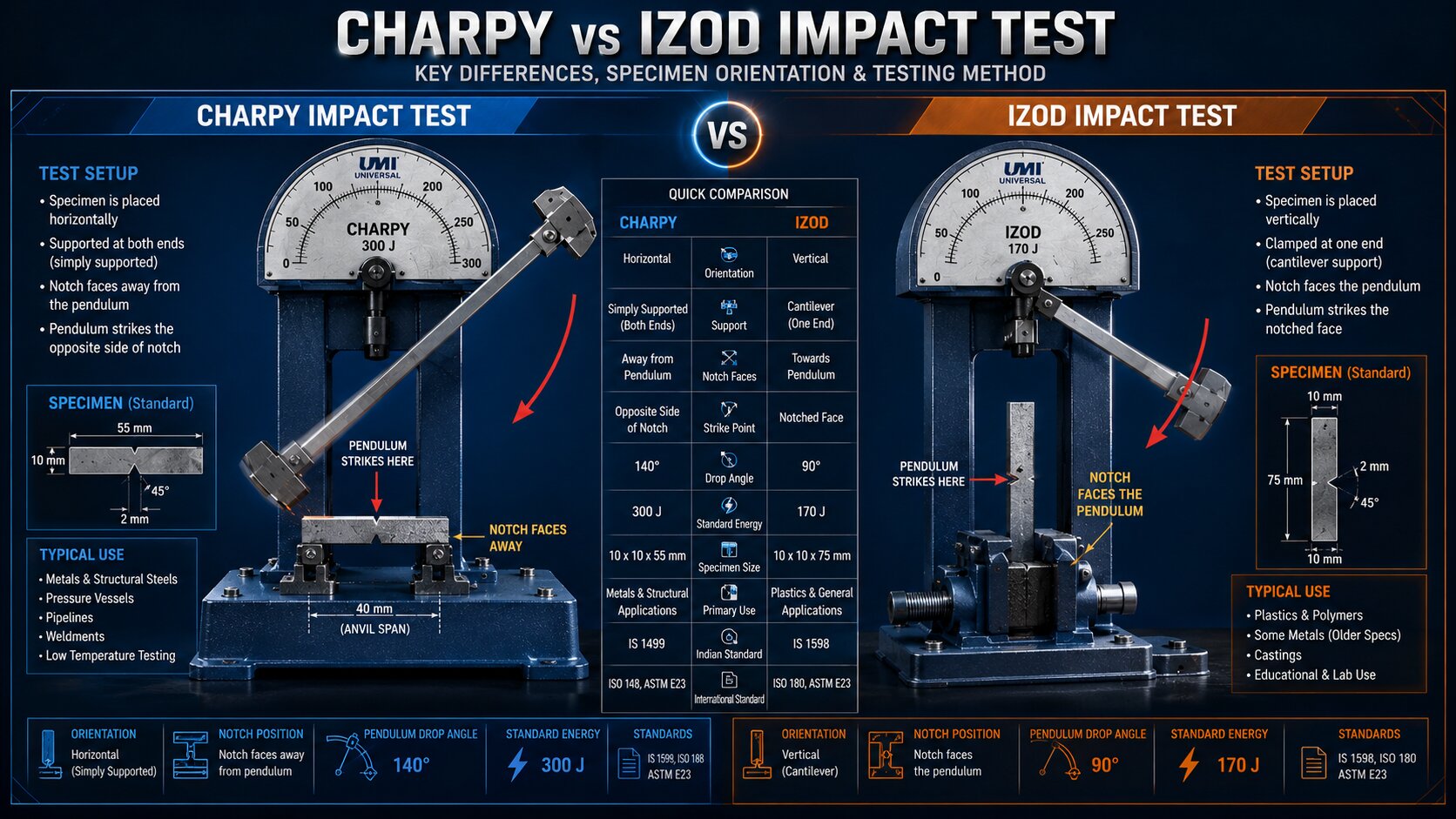
The Charpy and Izod tests use the same principle but differ significantly in specimen orientation, support, and application. Here is a complete side-by-side comparison:
| Parameter | Charpy Impact Test | Izod Impact Test |
| Specimen orientation | Horizontal — supported at both ends as a simply supported beam | Vertical — clamped at one end as a cantilever beam |
| Notch position | Notch faces away from pendulum; pendulum strikes back of notch | Notch faces the pendulum; pendulum strikes notched face |
| Standard drop angle | 140° (from vertical) | 90° (from vertical) |
| Initial pendulum energy | 300 Joules (standard metals machine) | 170 Joules (standard metals machine) |
| Standard specimen size | 10 × 10 × 55 mm (ISO 148 / IS 1499) | 10 × 10 × 75 mm (ISO 180 / IS 1598) |
| Notch type | V-notch (2mm deep, 45°) or U-notch (5mm deep) | V-notch (2mm deep, 45°) per IS 1598 |
| Indian Standard | IS 1499 (aligned with ISO 148) | IS 1598 (aligned with ISO 180) |
| ASTM Standard | ASTM E23 (Charpy section) | ASTM E23 (Izod section) |
| Most common application | Structural steel, pressure vessels, pipelines, weldments, metals | Plastics, polymers, some metals — more common in UK/older Indian specs |
| Low-temperature testing | Yes — extensively used for ductile-to-brittle transition studies | Limited — less suitable due to clamping constraints at low temp |
| Result unit | Joules (J) — may also be expressed per unit area (J/cm²) | Joules (J) or J/m for plastics |
| Who uses it more in India | Steel plants, structural labs, oil & gas, pressure vessel mfrs. | Engineering colleges, plastic testing, older foundry QC labs |
| Global preference | Dominant worldwide (especially Charpy V-notch, CVN) | Less common globally; mostly UK legacy and some Indian IS specs |
| UMI Universal Recommendation: For metals testing, structural steel qualification, pressure vessel materials, pipeline steels, and any application requiring IS 1499, ISO 148, or ASTM E23 compliance — specify the Charpy test configuration. For plastics, polymers, rubber, and older IS specifications citing IS 1598 — specify the Izod configuration. UMI’s pendulum impact testers are supplied as combination machines performing BOTH Charpy and Izod tests using interchangeable fixtures and strikers — giving you maximum flexibility from one machine. |
4. Key Components of an Impact Testing Machine
| Pendulum & Hammer Assembly The heart of the machine. A heavy pendulum arm (alloy steel) with a striker head precisely machined to the correct geometry per IS 1499/1598. The pendulum is mounted on sealed antifriction bearings to minimise energy losses from friction — critical for accurate absorbed energy measurement. Two interchangeable strikers: one for Charpy, one for Izod. | Main Frame Rigid cast iron or fabricated steel frame that absorbs the reaction forces during impact without flexing. Frame rigidity directly affects accuracy — a flexible frame absorbs some impact energy, giving falsely high absorbed energy readings. UMI machines use heavy, ground-flat base frames for stability. | |
| Specimen Support Anvils (Charpy) Two alloy steel anvils mounted on the base with a fixed 40mm span. Machined to precise radii (1mm radius per IS 1499). An end-stop ensures rapid, accurate specimen centring between the supports. Must be hardened and replaceable — worn anvils give incorrect results. | Izod Specimen Clamp & Vice A machined vice clamping the Izod specimen vertically to exactly the correct height (±0.1 mm) using an Izod setting gauge. The clamping torque must be sufficient to prevent movement during impact without introducing stresses. A machined vertical groove ensures correct specimen alignment. | |
| Scale & Drag Pointer (Analogue) / Encoder (Digital) Analogue: A calibrated arc scale in Joules with a friction-held drag pointer that records maximum pendulum rise. Digital: A high-resolution optical or magnetic encoder attached to the pendulum pivot records the exact rise angle electronically. Resolution ≥ 0.25 J per IS 1599 / ISO 148 Part 2 requirements. | Safety Guard & Brake A rigid guard protecting the operator from flying specimen fragments (which can travel at high velocity after fracture). A braking mechanism (brake shoe or electromagnetic brake) catches the pendulum after the test, preventing repeated swinging that could cause accidents. Mandatory per IS 1499 and essential for lab safety. | |
| Low-Temperature Sub-Zero Bath (Optional) For Charpy testing at low temperatures (−196°C to −20°C), specimens are cooled in a temperature-controlled bath (liquid nitrogen or refrigerant) and transferred rapidly to the machine for testing. Ductile-to-brittle transition temperature (DBTT) studies require testing at multiple temperatures. Available as an accessory from UMI Universal. | Control Panel & Software (Digital/Auto) Automatic machines feature a touch-screen HMI for programmed operation — automatic pendulum lift, auto-release, result display, and auto-braking. USB and printer connectivity for data output. Computerized models add PC software for energy vs. temperature curve plotting (DBTT analysis) and batch result storage. | |
5. Types of Impact Testing Machines
5.1 Analogue / Manual Impact Tester (Mechanical)
The classic design. Manual pendulum lift, friction drag pointer on arc scale, direct reading in Joules. Simple, robust, and lowest cost. Suitable for: training labs, small foundries, basic QC in workshops. Limitations: manual reading susceptible to parallax error; no data storage; operator must be careful with brake application.
| Feature | Specification |
| Charpy initial energy | 300 J |
| Izod initial energy | 170 J |
| Scale resolution | 2 J (Charpy), 1 J (Izod) — analogue pointer |
| Standards | IS 1499, IS 1598, BS 131 Part 4, BSEN 10045-2 |
| Price range India | ₹55,000 – ₹1,50,000 |
5.2 Digital Impact Tester (Electronic)
Replaces the analogue pointer with a microprocessor-based digital display. The pendulum rise angle is measured electronically by an encoder and converted to absorbed energy (J). Results display directly on an LCD screen, eliminating parallax reading error. Most digital machines also have a USB or RS-232 port for data transfer and an optional printer interface.
- Advantages over analogue: more accurate, operator-independent reading, digital memory, data output port
- Typical price range: ₹1,00,000 – ₹2,50,000
- Standards compliance: IS 1499, IS 1598, ASTM E23, ISO 148, ISO 180
5.3 Automatic / Fully Automatic Impact Tester
The highest specification machine. Touch-screen HMI, fully automatic pendulum lift via electromagnetic clutch and gearbox, auto-release through linear actuator, auto-braking after test, digital result display with USB/printer output. Some models include a door interlock safety enclosure so the operator is never exposed during the test sequence.
- Key features: touch-screen control, auto-lift, auto-release, auto-brake, ≥0.25 J resolution encoder, USB data logging
- Best for: NABL-accredited labs, high-volume production testing, R&D, IS 1499 Grade A compliance
- Typical price range: ₹2,50,000 – ₹8,00,000
5.4 Instrumented Charpy Impact Tester
An advanced research-grade machine with a force transducer on the striker that records force vs. time and force vs. displacement throughout the entire impact event — not just the total energy. Produces a complete impact force-time curve that reveals crack initiation energy vs. crack propagation energy, dynamic yield strength, and material fracture mechanics data. Used in research institutes, aerospace, and defence material qualification.
- Typical price range: ₹12,00,000 – ₹40,00,000+
6. Impact Test Specimen — Notch Types, Dimensions & Preparation
The notch geometry is the most critical aspect of impact specimen preparation. A precise, correctly dimensioned notch concentrates stress at the intended point and ensures reproducible fracture initiation. Incorrect notch depth, angle, root radius, or surface finish are the most common causes of impact test scatter and non-conforming results.
| Parameter | Charpy V-Notch (CVN) | Charpy U-Notch | Izod V-Notch |
| Specimen length | 55 mm | 55 mm | 75 mm |
| Cross-section | 10 × 10 mm | 10 × 10 mm | 10 × 10 mm |
| Notch depth | 2 mm | 5 mm | 2 mm |
| Notch angle | 45° | — (U-shape) | 45° |
| Notch root radius | 0.25 mm ± 0.025 | 1 mm ± 0.07 | 0.25 mm ± 0.025 |
| Notch length | — | — | 28 mm from clamp |
| Standard | IS 1499, ISO 148-1, ASTM E23 | IS 1499, ISO 148-1 | IS 1598, ISO 180 |
| Verification tool | Notch-dimension gauge (caliper gauge) | Same | Same |
| Machining method | V-notch milling cutter or broach | U-notch milling cutter or broach | V-notch milling cutter |
| Critical Preparation Notes: 1. Machine the notch last — after all other surfaces are finished. Machining sequence: saw to length → mill/grind faces → machine notch. 2. Use a calibrated notch-checking gauge (Charpy notch caliper) to verify depth, angle, and root radius of every specimen. Incorrect notch = invalid test. 3. Surface roughness of notch root must be ≤ 0.4 µm Ra — smoother root = sharper stress concentration = more reproducible crack initiation. 4. Sub-zero tested specimens must be transferred from cooling bath to machine in ≤ 5 seconds (IS 1499 requirement) — use insulated tongs supplied with the machine. 5. Specimen cross-section must be 10×10 mm ± 0.11 mm per IS 1499 — verify with micrometer before testing. |
7. Impact Testing Standards — India (IS) and International
| Standard | Full Title | Method | Key Requirements |
| IS 1499 | Impact Test for Metallic Materials — Charpy Test | Charpy (V & U notch) | Specimen 10×10×55mm; anvil span 40mm; striker radius 2mm; drop angle 140°; IS-compliant machine calibration |
| IS 1598 | Impact Test for Metallic Materials — Izod Test | Izod (V notch) | Specimen 10×10×75mm; pendulum 170J; drop angle 90°; clamping height ±0.1mm |
| IS 1757 | Impact Test — Charpy for Notched Bar Specimens | Charpy | Older standard — superseded by IS 1499 but still referenced in older material specs |
| ISO 148-1 | Metallic Materials — Charpy Pendulum Impact Test, Part 1: Test Method | Charpy | Aligned with IS 1499; widely required for export certifications and ISO-qualified supply chains |
| ISO 180 | Plastics — Determination of Izod Impact Strength | Izod | For plastics; unnotched, notched, and reverse notched specimen variants |
| ASTM E23 | Standard Test Methods for Notched Bar Impact Testing of Metallic Materials | Charpy + Izod | US standard; required for ASTM-specified material contracts, defence, oil & gas export |
| IS 1599 | Method of Bend Test | — | Often conducted alongside impact test to assess ductility — same machine frame used |
| ISO 148-2 | Verification of Pendulum Impact Testing Machines | Machine verification | Defines machine calibration requirements — complementary to IS 1499 for lab compliance |
| Need an Impact Testing Machine? Get a Free Quote from UMI Charpy + Izod combination machines — IS 1499/1598 & ASTM E23 compliant — Analogue, Digital & Automatic models. Manufacturer, Pune. +91-2025204168 | 🌐 universal-motion.com/contact-us/ [ Request Free Quote + Technical Datasheet ] |
8. What Does the Impact Test Result Tell You?
The absorbed energy value (in Joules) from a Charpy or Izod test communicates several critical engineering properties. Understanding the result helps you interpret certificates, set acceptance criteria, and diagnose material failures.
| Result / Concept | What It Means | Practical Implication |
| High absorbed energy (e.g. >100 J CVN) | Material is tough — it deforms plastically and absorbs large amounts of energy before fracturing | Safe for structural applications with dynamic loads; not brittle at the test temperature |
| Low absorbed energy (e.g. <20 J CVN) | Material is brittle at test temperature — fractures with minimal plastic deformation | Risk of catastrophic brittle fracture in service; review heat treatment, alloy selection, or operating temperature |
| Ductile fracture (fibrous appearance) | Fracture surface appears grey and fibrous — plastic tearing failure mode | Indicates ductile, tough material — desired for structural steels and pressure vessels |
| Brittle fracture (shiny/crystalline) | Fracture surface appears bright and crystalline — cleavage fracture mode | Indicates brittle failure — concerning for low-temperature service; DBTT may be above service temperature |
| Ductile-to-Brittle Transition Temperature (DBTT) | Temperature at which material transitions from high-energy ductile to low-energy brittle fracture | Critical for pipeline steels, offshore structures, Arctic applications — must test at multiple temperatures |
| Lateral expansion (mm) | Amount of plastic widening of specimen at fracture — measured perpendicular to loading | Required by some codes (ASME, API) as an additional toughness acceptance criterion alongside energy |
| % Shear fracture | Percentage of fracture surface showing fibrous (ductile) vs. crystalline (brittle) appearance | Tracked when testing at multiple temperatures to plot the ductile-brittle transition curve |
9. Competitor Analysis — Impact Testing Machine Market India 2026
Based on market research conducted May 2026, here are the key competitors UMI Universal faces for the ‘Impact Testing Machine’ keyword in the Indian market. Understanding their strengths and gaps reveals UMI’s differentiation opportunities.
| # | Competitor | Strength | Weakness / Gap | UMI Opportunity |
| 1 | FIE (Fine Group) Pune | Longest track record; NABL calibration; AutoImpact-30 fully auto model with enclosure; ranks Page 1 for most impact tester searches | Primarily focused on metals; premium pricing; long delivery lead times | Compete on price + faster delivery + combination Charpy+Izod as standard |
| 2 | MCS Testing Kolhapur | Strong Maharashtra presence; IS/BS compliant machines; competitive pricing | Dated website; thin content; weak international SEO | UMI can outrank on blog content depth and Pune location advantage |
| 3 | Presto Group Delhi NCR | Dominant for plastics/polymer impact testing; strong digital presence; extensive content marketing | Focused on plastics only — limited metals impact tester range | UMI covers metals + plastics + ASTM E23 — broader product positioning |
| 4 | Heicoin Gurgaon | Clear IS 1499/1598/1757 compliance messaging; good IndiaMart listing | Limited web presence; no blog content; no dedicated product pages | UMI’s blog content on IS 1499 standards will outrank this gap |
| 5 | Aticolab Ambala | Wide product range including impact testers; serves engineering colleges heavily | Lower quality positioning; thin spec sheets; mainly educational market | UMI’s industrial + educational dual positioning is a competitive advantage |
| UMI Universal’s Key Differentiator in Impact Testing: Most competitors either focus on metals (FIE, MCS) OR plastics (Presto). UMI Universal manufactures impact testing machines for both — with IS 1499/1598 compliance, ASTM E23, ISO 148/180, and the ability to supply sub-zero cooling baths, notch-cutting accessories, and specimen gauges as a complete package. Additionally, UMI’s Pune location and 23+ years of experience serving automotive, steel, and infrastructure sectors gives it credibility that newer competitors and traders cannot match. |
10. Industry Applications — Who Uses Impact Testing Machines?
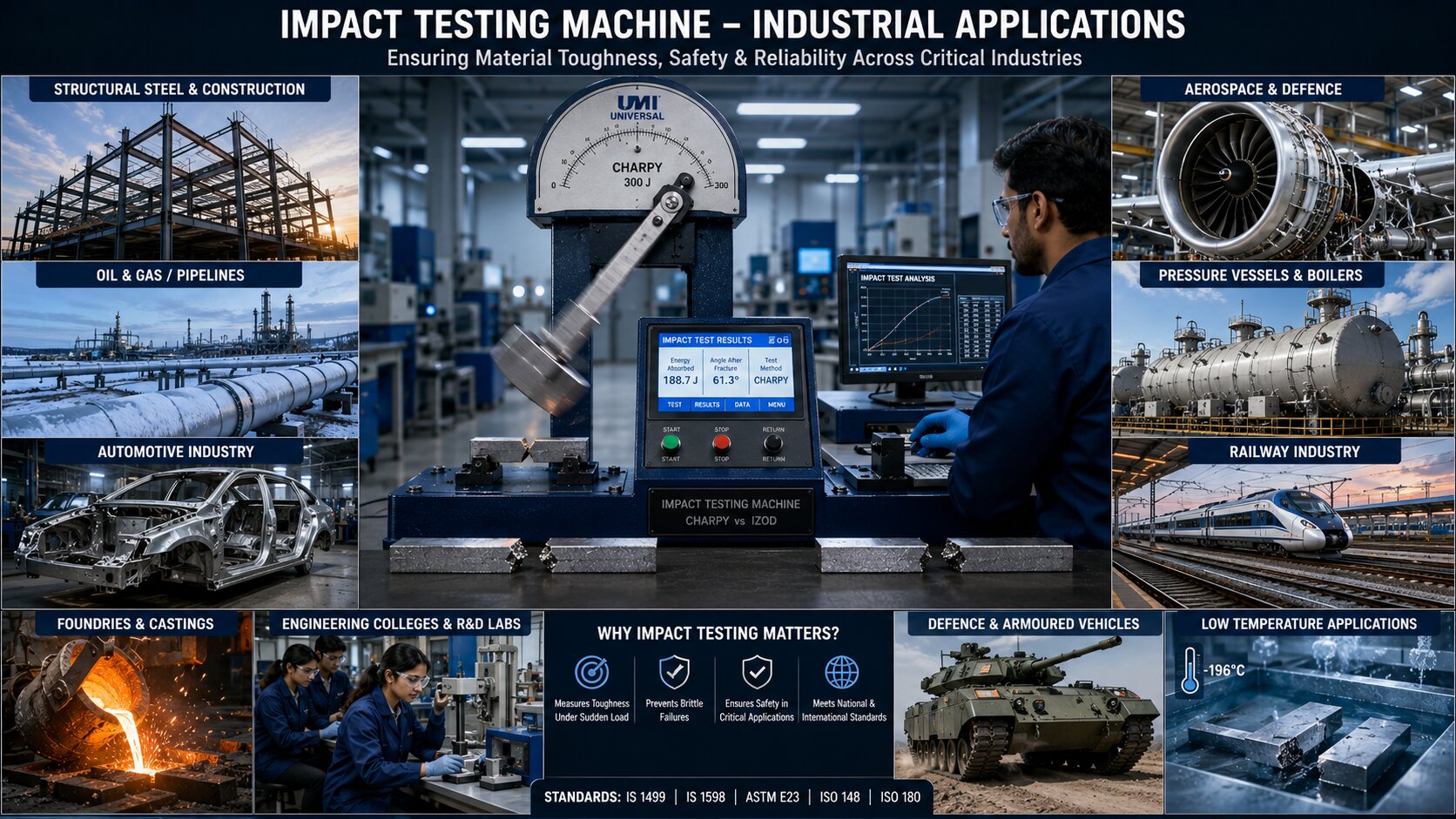
| Industry | Test Type | What Is Tested | Standard Applied |
| Structural Steel | Charpy CVN | Plates, beams, angles — toughness at service temperature | IS 2062, IS 1499, EN 10025 |
| Pressure Vessels & Boilers | Charpy CVN | Shell plates, nozzles, weld joints — low temp toughness | IS 2002, ASME VIII Div.1, ASTM E23 |
| Oil & Gas Pipelines | Charpy CVN (DWTT) | Line pipe steel — Arctic and low-temp service qualification | API 5L, DNV-OS-F101, ISO 3183 |
| Automotive | Charpy + Izod | Cast iron components, forged parts, polymer bumpers | IS 1499, ASTM E23, ISO 179/180 |
| Railway | Charpy CVN | Rails, bogies, wheel steel — impact resistance at variable temperatures | IS 3902, EN 13261 |
| Defence & Aerospace | Charpy CVN + Instrumented | Armour steel, aircraft structural alloys — high energy absorption | MIL-A-46100, AMS specs, ASTM E23 |
| Foundries & Castings | Charpy CVN | Grey iron, ductile iron, steel castings — toughness qualification | IS 1865, ASTM A536, ISO 1083 |
| Engineering Colleges & R&D | Charpy + Izod | All materials — teaching, research, ductile-brittle transition studies | IS 1499, IS 1598, ASTM E23 |
| Plastics & Polymers | Izod (notched/unnotched) | Injection-moulded parts, films, composites — impact resistance | IS 13360-5-3, ISO 180, ASTM D256 |
| Construction Steel | Charpy CVN | TMT rebars — cold temperature toughness (Fe500D, Fe600 grades) | IS 1786, IS 1499 |
UMI Universal supplies impact testing machines to steel plants, automotive Tier 1 and Tier 2 suppliers, engineering colleges, pressure vessel manufacturers, and foundries across India. Our machines are also exported internationally to clients in Africa and Southeast Asia. See our complete range of material testing machines including universal testing machines, tensile testers, and hardness testers for complete lab setup solutions.
11. How to Choose the Right Impact Testing Machine
Step 1 — Specify Your Test Method: Charpy, Izod, or Both?
Check your material standard or customer specification. Structural steel, pressure vessel, and most metals specifications cite the Charpy test (IS 1499, ASTM E23). Older Indian foundry and mechanical engineering specifications may cite IS 1598 (Izod). Plastics specifications (ISO 180, ASTM D256) require Izod. For maximum lab versatility, UMI Universal’s combination machines do both using interchangeable fixtures.
Step 2 — Determine Required Energy Capacity
Standard Charpy: 300 J (sufficient for virtually all structural steels). Standard Izod: 170 J. For very tough materials (austenitic stainless steels, HSLA steels with CVN > 200 J), ensure the machine has adequate capacity — a specimen that doesn’t fully fracture gives a minimum lower-bound reading, not the actual CVN value. For plastics, 25 J capacity is typical.
Step 3 — Choose the Automation Level
Basic QC or teaching lab → Digital impact tester (best value). High-volume production or NABL lab → Fully Automatic with touch-screen HMI and data logging. Research or DBTT studies → Instrumented Charpy with force-time data and low-temperature bath. UMI Universal offers all three levels.
Step 4 — Verify Notch-Cutting Accessories
Impact testing is only as accurate as the notch preparation. Ask whether V-notch and U-notch milling cutters, broaching tools, notch-checking gauges, specimen templates, and an Izod setting gauge are available from the same supplier. UMI Universal supplies a complete accessory kit as standard or optional add-on.
Step 5 — Confirm Standards Compliance and Calibration
Ensure the machine is manufactured and verified per IS 1499 / ISO 148-2 (machine verification standard). For NABL accreditation, the machine’s potential energy must be verified by a NABL-accredited calibration lab annually. Check that your supplier can facilitate this calibration and supply certified test blocks if needed.
12. Impact Testing Machine Price in India (2026)
| Machine Type | Method | Capacity | Price Range (INR) | Best For |
| Analogue Pendulum Impact Tester | Charpy + Izod | 300 J / 170 J | ₹55,000 – ₹1,50,000 | Teaching labs, basic QC, cost-sensitive buyers |
| Digital Impact Tester | Charpy + Izod | 300 J / 170 J | ₹1,00,000 – ₹2,50,000 | Production QC, IS 1499/1598, digital result output |
| Digital ASTM Impact Tester | Charpy (ASTM E23) | 300 J / 400 J | ₹1,50,000 – ₹3,50,000 | Oil & gas, defence, ASTM-specified contracts |
| Auto Impact Tester (Fully Automatic) | Charpy + Izod | 300 J / 170 J | ₹2,50,000 – ₹8,00,000 | NABL labs, high-volume QC, minimal operator intervention |
| Instrumented Charpy Tester | Charpy (force-time data) | 300–750 J | ₹12,00,000 – ₹40,00,000 | Research, aerospace, fracture mechanics, DBTT analysis |
| Low-Temperature Sub-Zero Bath | Accessory for Charpy | −196°C to −20°C | ₹1,50,000 – ₹5,00,000 | Arctic/low-temp qualified materials, pipeline steel, pressure vessel |
Note: Prices are indicative and subject to 18% GST, accessories, calibration, and freight. Contact UMI Universal at +91-2025204168 for customized pricing with your specific requirements.
13. Frequently Asked Questions — Impact Testing Machine
Most common questions from engineers, QC managers, and lab buyers evaluating impact testing machines.
Q: What is the difference between Charpy and Izod impact tests?
A: Both use a swinging pendulum to fracture a notched specimen, but they differ in specimen orientation and support. In the Charpy test, the specimen is placed horizontally, supported at both ends, and struck in the middle — like a beam in three-point bending. The notch faces away from the pendulum. In the Izod test, the specimen is clamped vertically at one end (like a flagpole), and the pendulum strikes the notched face near the free end — like a cantilever. Charpy is the globally dominant method for metals (IS 1499, ASTM E23, ISO 148), while Izod (IS 1598) is used in older Indian specs and for plastics. UMI Universal’s combination machine does both.
Q: What is Charpy V-notch impact value and why is it important?
A: Charpy V-notch (CVN) impact value is the energy absorbed (in Joules) when a 10×10×55mm specimen with a 2mm deep 45° V-notch is fractured by the Charpy pendulum at a specified temperature. It is the single most important toughness indicator for structural steels, pressure vessel steels, and pipeline materials. CVN requirements are specified in material standards (e.g. IS 2062 Grade E350, IS 2002 plates, API 5L Grade X65) as minimum Joules at a design temperature — typically 0°C, −20°C, or lower for cold-climate applications. A material failing its CVN requirement is rejected regardless of passing tensile and yield strength.
Q: How does temperature affect Charpy impact test results?
A: Most steels show a dramatic drop in Charpy impact energy as temperature decreases — transitioning from a high-energy ductile fracture mode to a low-energy brittle fracture mode. This transition occurs over a narrow temperature range called the ductile-to-brittle transition temperature (DBTT). Above the DBTT, the steel absorbs high energy (100+ J); below it, energy drops sharply (sometimes below 20 J). For structures operating at low temperatures — pipelines in cold regions, offshore platforms, Arctic vessels — the steel must have a DBTT well below the minimum service temperature. This is determined by testing Charpy specimens at multiple temperatures and plotting the energy vs. temperature curve.
Q: What is the minimum energy capacity I need for testing structural steel?
A: A standard 300 J Charpy machine is adequate for all common structural steels, including IS 2062 grades, IS 2002 pressure vessel plates, API 5L pipeline steels, and TMT rebars (IS 1786 Fe500D, Fe600 grades which specify minimum Charpy values). If testing very tough materials like austenitic stainless steels, certain HSLA grades, or specimens that don’t fully fracture at 300 J, a higher-capacity machine (450 J or 750 J) may be needed. If the specimen doesn’t fully fracture, the result is recorded as a minimum bound value — not the true CVN — which may be non-conforming.
Q: Is a sub-zero cooling bath required for standard impact testing?
A: It depends on your material specification. If your test standard requires impact testing at temperatures below 0°C (such as −20°C, −40°C, or −60°C as specified in pressure vessel codes, pipeline specs, or offshore structural standards), then yes — a sub-zero cooling bath is mandatory. For room temperature testing (0°C and above), the bath is not needed. UMI Universal supplies sub-zero cooling baths (liquid nitrogen or refrigerant-cooled) as an accessory to the impact tester. The specimens must be transferred from bath to machine in ≤ 5 seconds as required by IS 1499.
Q: Can the same impact testing machine test both metals and plastics?
A: Yes and no. The pendulum frame and mechanism can be the same, but the energy capacity is very different. Metals require 170–300 J (Charpy/Izod metal machines). Plastics require only 1–25 J (ISO 179/180, ASTM D256) — and if you use a 300 J metal machine to test plastics, the absorbed energy (2–5 J) will be less than 1% of the machine’s capacity, making measurement accuracy very poor. For plastics, a dedicated small-capacity impact tester (0–25 J range) with appropriate fixture and specimen size is required. UMI Universal can advise the right configuration for mixed-material labs.
Q: How often should an impact testing machine be calibrated?
A: Annual calibration is the standard requirement. Calibration per ISO 148-2 (or IS 1499 Annex) involves verifying the machine’s potential energy, striker geometry, anvil dimensions, and pendulum bearing friction using calibrated reference specimens (certified Charpy verification specimens, such as those available from NIST or BSI). For NABL-accredited labs, calibration must be performed by a NABL-accredited calibration laboratory, and the certificate must be traceable to national standards. Interim checks using reference test blocks after any relocation, repair, or suspected overload are also recommended.
Q: Does UMI Universal supply notch-cutting accessories for impact test specimens?
A: Yes. UMI Universal supplies a complete specimen preparation accessory kit including V-notch and U-notch milling cutters (for fitting in a milling machine or broaching machine), V-notch and U-notch broaching tools (for use in a hydraulic press), a notch-dimension checking caliper gauge (to verify notch depth, angle, and root radius per IS 1499), a specimen template for checking 10×10mm cross-section, and an Izod setting gauge for correct specimen height in the Izod vice. A notch milling attachment that fits standard milling machines is also available. Contact our sales team for a complete accessory kit quotation.
14. Conclusion — Choosing the Right Impact Testing Machine
The impact testing machine — whether Charpy, Izod, or both — is an indispensable instrument in any material testing laboratory where toughness, dynamic load resistance, and temperature performance matter. It provides data that tensile testing, hardness testing, and non-destructive methods simply cannot replicate.
To summarise the key selection guidance from this guide:
- Choose Charpy for metals, structural steel, pressure vessels, pipelines, and all IS 1499 / ASTM E23 applications
- Choose Izod for plastics, polymers, and applications citing IS 1598 or ISO 180
- Choose a combination machine for maximum versatility — one machine, both methods, interchangeable fixtures
- Choose Digital or Automatic for NABL labs, certified testing, and production QC requiring traceable records
- Always verify notch preparation — the most common cause of incorrect impact test results is incorrect notch geometry
UMI Universal Motion manufactures pendulum impact testing machines at our Pimpri-Chinchwad, Pune facility. Our machines comply with IS 1499, IS 1598, ASTM E23, ISO 148, and ISO 180. Explore related products and guides:
- Universal Testing Machines — tensile, compression, bend testing
- Hardness Testing Machines — Vickers, Brinell, Rockwell, Portable
- Blog: Tensile Testing Machine — Working Principle & Complete Guide
- Blog: Vickers vs Brinell vs Rockwell — Hardness Testing Comparison
- Blog: Universal Testing Machine Price in India 2026 — Buyer’s Guide
- Contact UMI Universal — free consultation, quote, and technical guidance
| Get Your Free Impact Testing Machine Quote — UMI Universal Charpy + Izod Combination • IS 1499 / IS 1598 / ASTM E23 Compliant • Analogue, Digital & Automatic • Pune Manufacturer ☎ +91-2025204168 | 🌐 universal-motion.com/contact-us/ [ Request Free Quote + Technical Datasheet ] |