Tensile Testing Machine: Working Principle, Types, Price in India (2026 Guide)
Every material that goes into a product — steel rebar in a bridge, aluminium sheet in a car door, plastic film in food packaging, or wire rope on a crane — must be tested to confirm it can handle the forces it will face in real life. The most fundamental of those tests is the tensile test, and the machine that performs it is the tensile testing machine.
Whether you are setting up a new QC lab, replacing an ageing tester, or evaluating machines for NABL accreditation, this guide covers everything you need to know — from how a tensile testing machine works and what the stress-strain curve tells you, to which standards apply and how to choose the right machine for your specific materials and budget.
UMI Universal Motion manufactures a complete range of tensile testing machines and universal testing machines from our Pimpri-Chinchwad facility in Pune. This guide draws on 23+ years of hands-on experience supplying tensile testers across India and internationally.
1. What Is a Tensile Testing Machine?
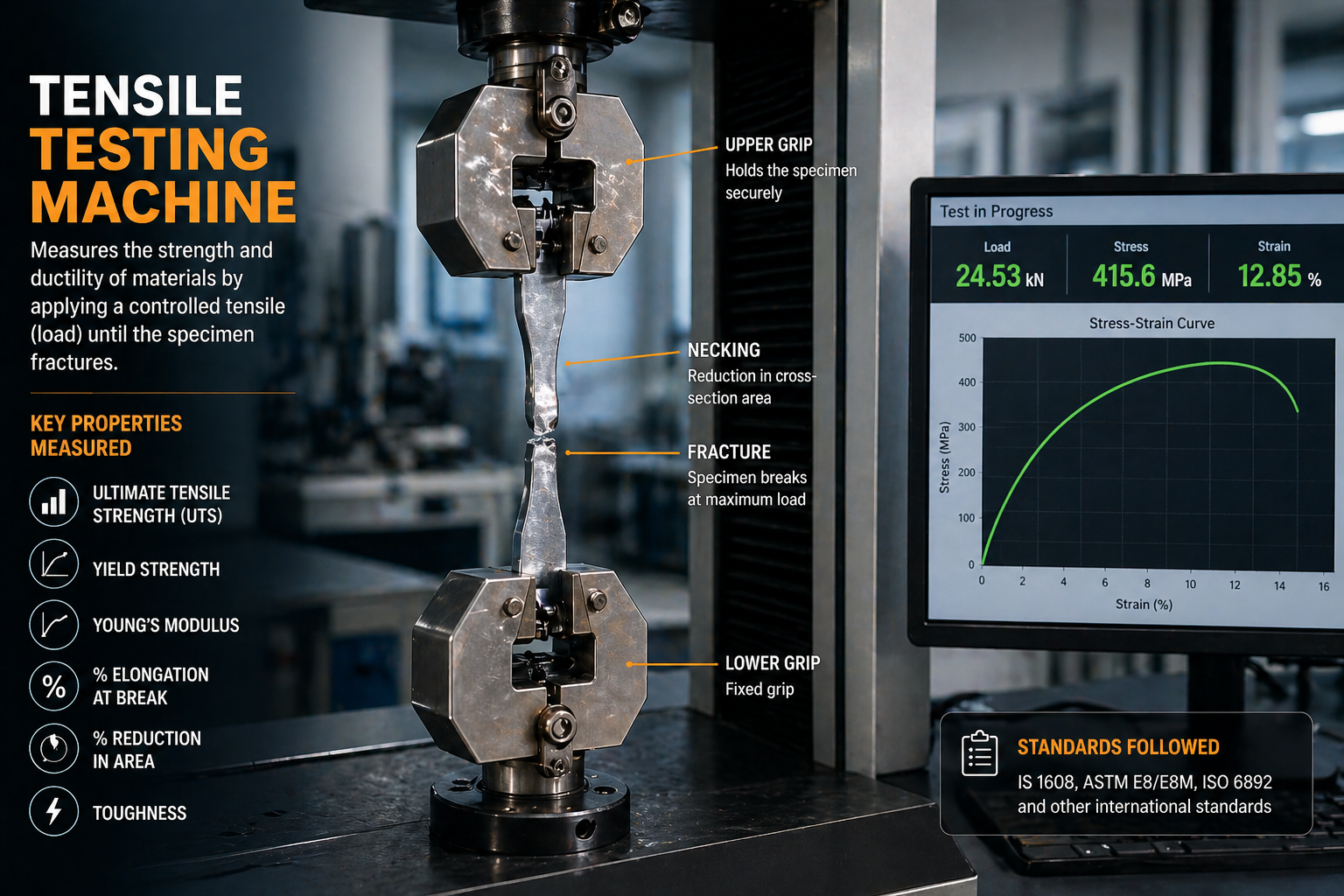
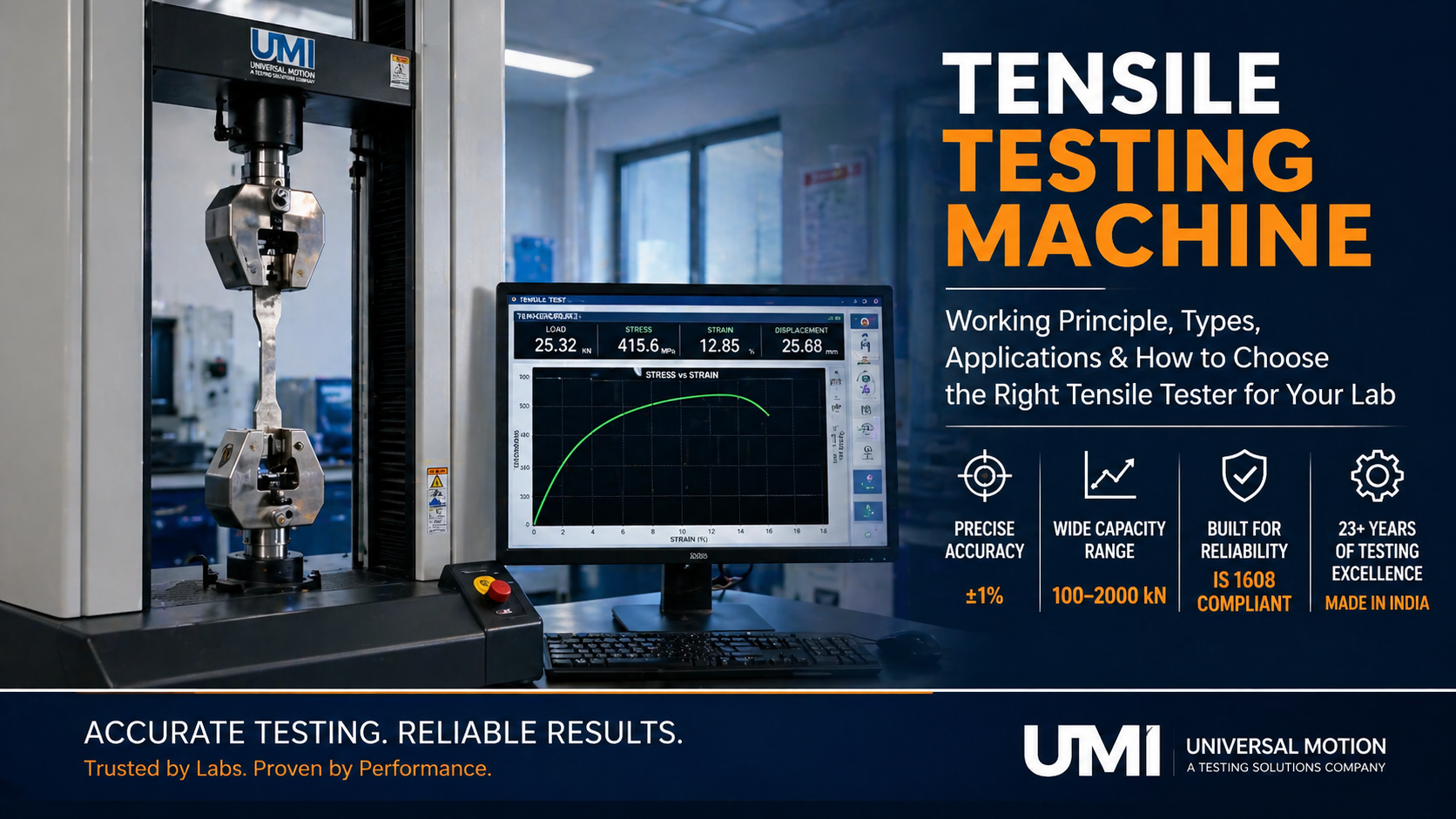
A tensile testing machine (also called a tensile strength tester, tension testing machine, or pull testing machine) is a precision instrument that applies a controlled, uniaxial pulling force (tension) to a material specimen until it fractures or reaches a defined load or elongation limit. Throughout the test, the machine continuously records the applied force and the specimen’s deformation, generating a stress-strain curve that reveals the material’s complete mechanical behaviour under load.
Key mechanical properties measured in a tensile test include:
- Ultimate Tensile Strength (UTS) — maximum stress before fracture
- Yield Strength / 0.2% Proof Stress — stress at which permanent deformation begins
- Young’s Modulus (E) — material stiffness (slope of elastic region)
- % Elongation at Break — ductility measure; how much the material stretches before fracturing
- % Reduction in Area — ductility in cross-section; important for metals
- Energy at Break (Toughness) — area under the stress-strain curve
Tensile testing machines are one of the most widely used instruments in materials testing globally. In India alone, thousands of labs across steel, automotive, construction, polymer, textile, and defence sectors run tensile tests daily — many under IS 1608, IS 1786, IS 2062, ASTM E8M, and ISO 6892 standards, which specify exact test conditions and required results.
2. Working Principle — How a Tensile Test Is Performed
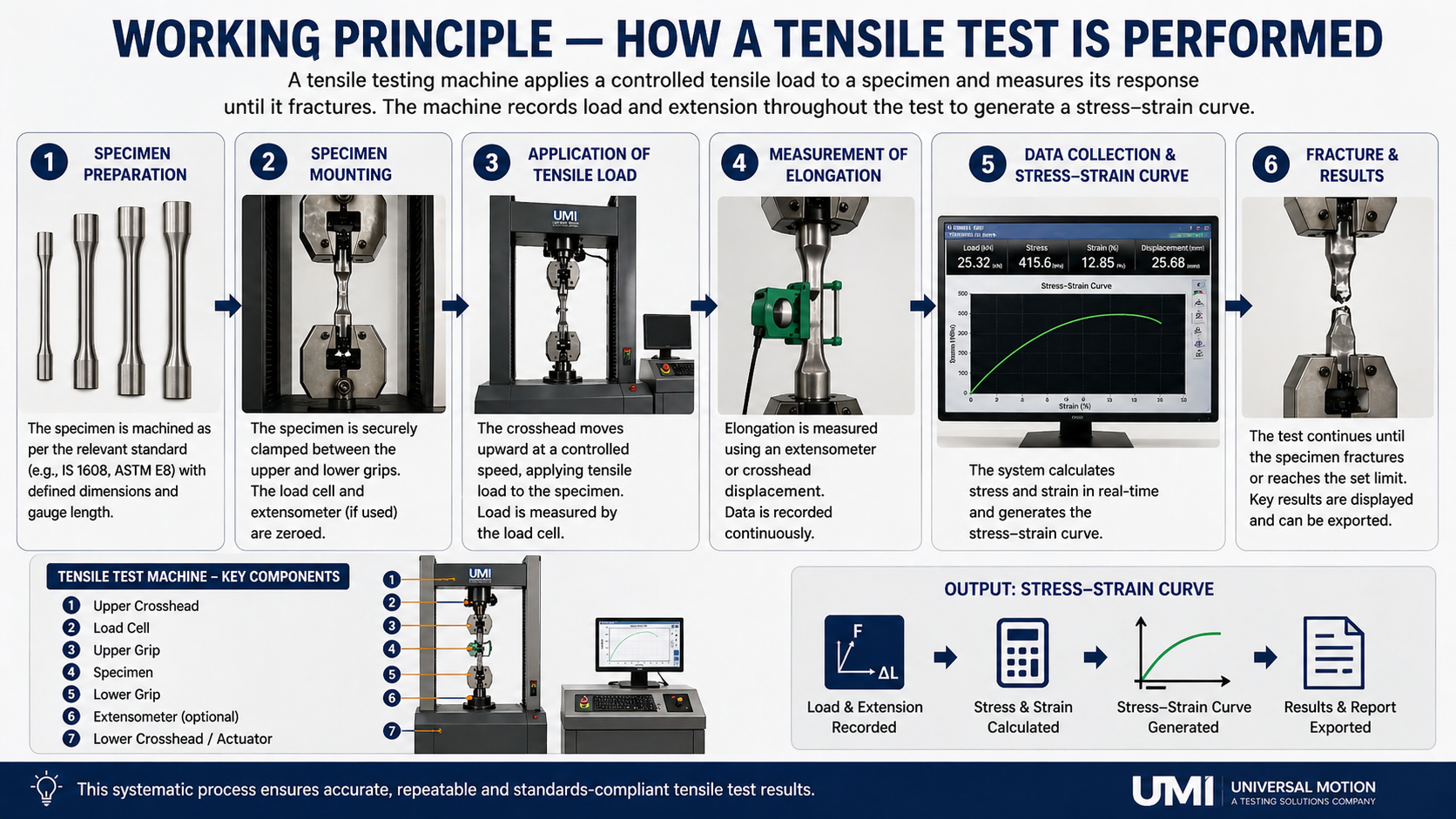
The working principle of a tensile testing machine is elegantly straightforward: apply a controlled, increasing force to a specimen along a single axis, and measure the specimen’s response until it fails. In practice, a modern computerized tensile testing machine performs this through the following precise steps:
Step 1 — Specimen Preparation
The specimen is machined or cut to a standardized shape and size defined by the applicable test standard. For metals, IS 1608 (or ASTM E8M) defines the gauge length, cross-section dimensions, and shoulder radii for flat or round specimens. The gauge length (L₀) is marked on the specimen before testing for elongation measurement. For plastics, IS 13360 defines dumbbell-shaped specimens. For textiles and films, strips of defined width are used.
Step 2 — Specimen Mounting and Zeroing
The specimen is clamped securely into the machine’s upper and lower grips. Grip alignment is critical — any eccentricity introduces bending forces that corrupt results. The software zeros the load cell and crosshead displacement encoder before the test begins, ensuring all measurements are taken from a true reference point.
Step 3 — Test Execution at Controlled Rate
The crosshead moves upward (for tensile tests) at the programmed speed, applying a steadily increasing tensile force to the specimen. The speed is set per the test standard — for example, IS 1608 specifies 5–20 mm/min for metallic materials in the elastic region. In a computerized UTM, the software monitors the actual speed and adjusts the hydraulic flow or servo drive continuously to maintain the set rate.
Step 4 — Real-Time Data Acquisition
Throughout the test, the load cell and crosshead encoder (or attached extensometer) capture force and displacement data hundreds of times per second. The software converts these into stress (force ÷ cross-section area) and strain (elongation ÷ original gauge length) and plots the stress-strain curve live on screen. The operator can watch the curve build in real time.
Step 5 — Automatic Break Detection and Machine Stop
When the specimen fractures, a sudden drop in load is detected by the machine’s auto-break detection system. The crosshead motor stops immediately — protecting the grips from impact and preventing rebounding. In compression and bend tests, the machine stops at a set deflection or load limit instead.
Step 6 — Automatic Result Calculation and Reporting
In under 2 seconds, the software calculates UTS, yield strength, Young’s modulus, % elongation, and % reduction in area from the saved data. A test certificate — including the stress-strain graph, specimen details, test parameters, and all results — is generated in PDF or Excel format, ready to print or archive. All data is stored in the onboard database for batch tracking and audit retrieval.
| Key Formula Reference Stress (σ) = Applied Force (F) ÷ Original Cross-Section Area (A₀) [Unit: MPa or N/mm²] Strain (ε) = Change in Length (ΔL) ÷ Original Gauge Length (L₀) [Dimensionless or %] Young’s Modulus (E) = Stress (σ) ÷ Strain (ε) [Unit: GPa] (elastic region only) % Elongation = (Final Gauge Length − L₀) ÷ L₀ × 100 |
3. The Stress-Strain Curve — Explained Zone by Zone
The stress-strain curve is the heart of a tensile test. It is a graphical map of how a material behaves from initial loading all the way to fracture. Understanding each zone of the curve is essential for engineers selecting materials and interpreting test results.
| Zone | Stress-Strain Behaviour | What It Tells You |
| ① Elastic Zone | Straight line from origin — material stretches proportionally and fully recovers if load removed. Slope = Young’s Modulus (E) | E value (stiffness). High E = rigid material (steel). Low E = flexible (rubber) |
| ② Yield Point | Curve bends — material begins permanent (plastic) deformation. Upper/Lower yield points visible for mild steel | Yield Strength (Rp0.2 or ReH/ReL). Critical for structural design — never design beyond this |
| ③ Strain Hardening | Curve rises but less steeply — material strengthens as dislocations multiply and tangle in crystalline structure | Material toughness. Wider zone = tougher, more ductile material |
| ④ Ultimate Tensile Strength | Peak of the curve — maximum stress the material can withstand | UTS (Ultimate Tensile Strength). Most commonly specified property in material standards |
| ⑤ Necking & Fracture | Curve drops sharply as specimen cross-section reduces locally (necks) and fractures | % Elongation, % Reduction in Area — ductility indicators |
Different materials produce characteristically different curve shapes. Mild steel shows a clear upper and lower yield point. High-strength steel may show no distinct yield point — requiring the 0.2% offset proof stress method. Plastics show a more gradual, drawn-out curve with a large necking region. Rubber and elastomers stretch enormously before fracture with a non-linear elastic region.
4. Key Components of a Tensile Testing Machine
A modern tensile strength testing machine consists of the following critical components. Understanding each one helps you evaluate machine quality and performance when comparing suppliers.
| Load Frame The structural backbone. A rigid dual-column (or single-column for smaller machines) steel frame that holds all components in precise alignment under full test load. Frame stiffness directly affects measurement accuracy — poor frames flex and give false elongation readings. | Load Cell The force measurement sensor. A high-accuracy strain-gauge based transducer (S-type or column type) that converts applied force into an electrical signal. Accuracy: ±0.5–1.0% of indicated load. Must be NABL-calibrated annually for compliance with IS 1828 / ASTM E4. | |
| Grips & Fixtures Hold the specimen securely without slippage or induced bending. Wedge grips (self-tightening) are standard for flat and round metal specimens. Pneumatic grips for soft materials. Capstan grips for textiles and fibres. Rope grips and chain grips for wire ropes and strand cables. | Control System & Software The brain of the machine. Controls crosshead speed, monitors load in real time, detects specimen break, calculates all result parameters, generates test reports, and stores data. Look for: Windows-based software, IS/ASTM test method libraries, Excel/PDF report export, and a searchable specimen database. | |
| Extensometer A precision clip-on or non-contact sensor that measures elongation directly at the specimen’s gauge length — more accurate than crosshead displacement alone (which includes grip slip and machine deformation). Required for accurate Young’s modulus measurement per IS 1608 / ASTM E8M. | Crosshead Drive Moves the upper or lower grip at a controlled speed. Hydraulic: flow control valve drives hydraulic cylinder. Electromechanical: precision ball-screw or lead-screw driven by servo motor. Each has advantages for different capacity ranges and material types. | |
| Safety Interlocks Overload protection stops the machine if load exceeds a set limit (protects load cell). Over-travel switches prevent crosshead from exceeding its physical limits. Specimen break detection stops the motor instantly at fracture. Essential for operator safety and equipment protection. | Hydraulic Power Unit Present in hydraulic UTMs. A motor-pump unit generates oil pressure to drive the hydraulic cylinder. Includes pressure gauge, relief valve, and oil reservoir. Requires periodic oil and filter maintenance. Separate unit connected to main frame by high-pressure hoses. | |
5. Types of Tensile Testing Machines
Tensile testing machines are broadly classified by their loading mechanism, control system, and capacity range. Choosing the right type is as important as choosing the right capacity.
5.1 Hydraulic Tensile Testing Machine
Uses oil-pressure hydraulic loading to apply tensile force. Best suited for medium to high capacities (100 kN to 2000 kN) — making them the standard choice for metals, TMT bars, wire ropes, structural components, and post-tensioning cables.
- Advantages: High force capacity, robust, cost-effective at large loads, easily serviced in India
- Limitations: Speed control less precise than servo; requires oil maintenance; not ideal for very low loads or soft materials
- Typical price range: ₹4,00,000 – ₹22,00,000 depending on capacity and computerization
5.2 Electromechanical Tensile Testing Machine
Uses a servo motor and precision ball-screw to apply force. Preferred for low to medium capacities (1 kN to 100 kN) where speed precision and smooth crosshead motion are critical — plastics, rubber, films, fibres, composites, and research applications.
- Advantages: Precise speed control (0.001 to 500 mm/min range), quiet, low maintenance, no oil
- Limitations: Higher cost at equivalent capacity; less suitable for impact-type loading
- Typical price range: ₹3,50,000 – ₹18,00,000
5.3 Computerized / Servo-Hydraulic Tensile Testing Machine
A hydraulic machine with a servo valve replacing the manual flow valve for closed-loop control. Provides the best of both worlds — high capacity of hydraulic loading with servo-precision control. Used in research institutes, NABL labs, aerospace, defence, and automotive R&D.
- Advantages: Precise load rate, strain rate, and displacement rate control; suitable for cyclic and fatigue testing
- Typical price range: ₹18,00,000 – ₹45,00,000+
5.4 Dedicated Tensile Tester vs Universal Testing Machine (UTM)
A dedicated tensile testing machine is optimized for pull tests only — simpler, sometimes more compact and cost-effective. A Universal Testing Machine (UTM) performs tensile, compression, bend, shear, and peel tests using interchangeable fixtures — more versatile and better value if your lab needs multiple test types. UMI Universal offers both configurations.
6. Tensile Test Standards in India and Internationally
The tensile testing machine must be set up, operated, and calibrated according to the standard that governs the material being tested. Here are the most important standards used in India:
| Standard | Scope | Key Requirements |
| IS 1608 (Pt.1&2) | Metallic materials tensile testing — India’s primary standard (aligned with ISO 6892-1) | Specimen shape & dimensions; speed 5–20 mm/min elastic / 2–20 mm/min plastic; extensometer required for E |
| IS 1786 | TMT reinforcement bars for concrete | Yield strength, UTS, elongation specified by grade (Fe415, Fe500, Fe500D, Fe550, Fe600) |
| IS 2062 | Structural steel | Yield strength, UTS, elongation minimum values for grade E165 to E550 |
| IS 13360 (Part 5) | Plastics tensile testing | Dumbbell specimens; speed 50 mm/min (rigid) or 500 mm/min (flexible) |
| IS 3400 | Rubber tensile testing | Dumbbell Die-C specimens; speed 500 mm/min |
| ASTM E8 / E8M | Metallic materials tensile — US standard | Common for export QC, automotive supplier specs, and defence contracts |
| ISO 6892-1 | Metallic materials tensile — international standard | Method A (strain rate controlled) and Method B (stress rate controlled) |
| IS 1828 / ASTM E4 | Machine verification & calibration | Machine accuracy must be ±1% (Grade 1) or ±2% (Grade 2) — mandatory for certified labs |
| Important: Don’t Confuse Material Standard with Machine Standard IS 1608 tells you HOW to test the specimen (speed, specimen shape, which results to report). IS 1828 tells you HOW ACCURATE the machine must be (±1% load, ±0.5% crosshead speed). Both must be satisfied. Your material test certificate is only valid if your machine is IS 1828 compliant AND the test is run per IS 1608. |
7. Materials Tested & Industries That Use Tensile Testing Machines
| Industry | Materials Tested | Standard Applied | What They Measure |
| Steel & Metals | TMT rebars, structural steel, wire rope, fasteners, tubes | IS 1608, IS 1786, IS 2062, ASTM A370 | UTS, yield strength, elongation, reduction in area |
| Automotive | Sheet metal, spring steel, seat belt webbing, adhesives | IS 1608, ASTM E8M, ISO 6892 | Forming limits, high-strength steel properties, bond strength |
| Construction / Civil | Rebar, post-tensioning strands, anchor bolts, geotextiles | IS 1786, IS 14268, ASTM A416 | Breaking load, elongation, 1% proof load of strand |
| Plastics & Rubber | Injection-moulded parts, films, sheets, elastomers | IS 13360, IS 3400, ASTM D638, D412 | Tensile modulus, elongation, tear resistance |
| Textiles & Fibre | Yarn, fabric, rope, geogrid, nonwovens | IS 1670, ASTM D5035, ISO 13934 | Breaking force, elongation, loop strength |
| Aerospace & Defence | Aluminium alloys, titanium, composites, high-temp alloys | ASTM E8M, MIL-HDBK-5 | Yield, UTS at temperature, fatigue life basis |
| Packaging | BOPP films, laminates, heat-seal bonds, paper | ASTM D882, IS 2508 | Tensile strength, peel strength, seal strength |
| Engg. Colleges & R&D | Any student or research specimen | IS 1608, ASTM E8M, ISO 6892 | Complete characterization — all properties |
UMI Universal supplies tensile testing machines to all of the above sectors — including specialized equipment like the 7-strand UTM for post-tensioning cable testing used by bridge and infrastructure contractors. See also our range of civil engineering laboratory testing equipment for concrete, soil, and rock testing.
| Need a Tensile Testing Machine for Your Lab? Tell UMI Universal your material type, capacity requirement, and applicable standard. We will recommend the right machine and send you a free technical datasheet within 24 hours. ☎ +91-2025204168 | 🌐 universal-motion.com/contact-us/ [ Request Free Quote + Technical Datasheet ] |
8. How to Choose the Right Tensile Testing Machine
Selecting the wrong machine is an expensive mistake. Follow this 6-step process to specify the right tensile testing machine for your lab:
Step 1 — Define Your Materials and Specimen Types
List every material you will test. Hard metals (steel rebar, bolts)? Soft materials (rubber, film)? A mix? The material hardness and expected load determine whether you need a hydraulic machine (metals, high loads) or electromechanical (soft materials, precise low-load control). Also define: flat specimens or round bar? Standard dimensions or non-standard shapes?
Step 2 — Determine Required Capacity
Calculate the maximum force your highest-strength specimen will require. For round metal bars: F_max = UTS × cross-section area. Add a 20% safety margin and round up to the next machine capacity (100 / 200 / 400 kN etc.). Avoid over-specifying — running tests below 2% of machine capacity reduces accuracy.
Step 3 — Check Standards Compliance
Confirm the machine meets IS 1828 (and ASTM E4 or ISO 7500-1 if required). Ask specifically: what is the accuracy class? (Grade 1 = ±1% is mandatory for NABL labs). Does the software calculate all the result parameters required by your material standard (IS 1608, IS 1786, etc.)?
Step 4 — Specify Fixtures for Your Tests
Standard machines come with basic wedge grips for flat tensile specimens. If you test round bars, threaded specimens, wire rope, chain, rubber dumbbell, or fabric strips, you need specific fixtures. Always list your specimen types when requesting a quote — fixture cost can add 10–30% to the machine price.
Step 5 — Evaluate the Extensometer Requirement
For accurate Young’s modulus measurement (required in IS 1608), a clip-on extensometer is needed in addition to the crosshead encoder. Ask whether an extensometer is included or optional. For thin films and soft materials, non-contact video extensometers avoid specimen damage from clip-on devices.
Step 6 — Verify Service Network
A tensile tester needs annual IS 1828 calibration, periodic load cell verification, and occasional grip replacement. Confirm: Does the manufacturer have engineers in your region? What is the typical response time? Are spare load cells and grips available in India? UMI Universal is headquartered in Pune with pan-India service capability.
9. Tensile Testing Machine Price in India (2026)
Tensile testing machine prices in India vary widely based on capacity, loading type, and control system. Here is a realistic price guide for 2026:
| Machine Type & Capacity | Loading System | Price Range (INR) | Best For |
| 5–20 kN — Basic Electromechanical | Motor + ball screw | ₹1,50,000 – ₹3,50,000 | Films, fibres, textiles, small lab budgets |
| 50 kN Electromechanical Computerized | Servo motor + ball screw | ₹3,50,000 – ₹8,00,000 | Plastics, rubber, composites, R&D labs |
| 100 kN Hydraulic Digital | Hydraulic cylinder | ₹4,00,000 – ₹7,50,000 | TMT bars, metals, small workshops |
| 100 kN Computerized Hydraulic | Hydraulic + PC software | ₹7,00,000 – ₹12,00,000 | NABL labs, QC for steel & auto parts |
| 200–400 kN Computerized Hydraulic | Hydraulic + PC software | ₹10,00,000 – ₹18,00,000 | Heavy industry, structural steel testing |
| 600–1000 kN Computerized Hydraulic | Hydraulic + PC software | ₹16,00,000 – ₹28,00,000 | Wire rope, rebar, infrastructure labs |
| 7-Strand / Post-Tensioning UTM | Heavy-duty hydraulic | ₹18,00,000 – ₹40,00,000 | Prestressed concrete cable & wedge testing |
Note: All prices are indicative and subject to GST @18%, accessories, calibration, and freight. Contact UMI Universal for exact pricing with specifications: +91-2025204168 or universal-motion.com/contact-us/
For a deeper look at UTM pricing factors, read our earlier guide: Universal Testing Machine Price in India 2026 — Complete Buyer’s Guide.
10. Frequently Asked Questions — Tensile Testing Machine
These are the most common questions engineers and lab managers ask before buying or using a tensile testing machine.
Q: What is the difference between a tensile testing machine and a Universal Testing Machine (UTM)?
A: A tensile testing machine is specifically designed and optimised for tensile (pull) tests. A Universal Testing Machine (UTM) performs tensile, compression, bending, shear, and peel tests using interchangeable fixtures on the same frame. In practice, most modern tensile testing machines sold in India are UTMs with tensile grips — because the additional capability costs relatively little more. If your lab needs only tensile tests, a dedicated tensile tester may be more compact and cost-effective. If you need tensile plus any other test type, a UTM is the better investment.
Q: What is tensile strength and how is it measured?
A: Tensile strength (also called Ultimate Tensile Strength or UTS) is the maximum stress a material can withstand while being pulled before it fractures. It is calculated as: UTS = Maximum Force ÷ Original Cross-Section Area of the specimen. The unit is MPa (megapascals) or N/mm² — these are numerically equivalent. For example, Fe500 grade TMT rebar must have a UTS of at least 545 MPa per IS 1786.
Q: What is the correct test speed for a tensile test?
A: The test speed depends on the material and the applicable standard. IS 1608 (metallic materials) specifies: elastic region: crosshead speed must produce a stress rate of 2–20 N/mm²/s; plastic region: 0.4× the gauge length per minute (e.g., 25 mm/min for a 62.5 mm gauge length specimen). ASTM E8M uses a crosshead speed of 5–50 mm/min for metals. IS 13360 for plastics: 50 mm/min for rigid, 500 mm/min for flexible. Always confirm the required speed before running your test — using the wrong speed gives incorrect yield strength and elongation values.
Q: Do I need an extensometer for a tensile test?
A: For accurate Young’s modulus (E) measurement, yes — an extensometer is required by IS 1608 and ASTM E8M. An extensometer clips onto the gauge length of the specimen and measures elongation directly at the specimen, eliminating errors from grip slip and machine frame deformation. For routine UTS and elongation tests in manufacturing QC (not requiring E), crosshead displacement measurement from the machine is generally acceptable. For NABL accredited testing, verify with your accreditation body whether extensometer use is mandatory for your test scope.
Q: Can one tensile testing machine test both metals and plastics?
A: Yes, but with important caveats. Metals typically require forces of 10–1000 kN, while plastics typically require 0.1–20 kN. A large hydraulic UTM may not measure low plastic forces accurately (below 2% of capacity). The best solution is either: a multi-range load cell system (some machines support swappable load cells), or two machines — one hydraulic for metals and one electromechanical for polymers. At UMI Universal, we can advise the most cost-effective configuration for mixed-material labs.
Q: How often should a tensile testing machine be calibrated?
A: Annual calibration is the standard requirement for NABL-accredited labs and ISO-certified factories. Calibration must be performed by a NABL-accredited calibration laboratory according to IS 1828 (ISO 7500-1). In addition to annual calibration, interim verification (using calibrated reference weights or proving rings) is recommended quarterly or after any machine relocation, repair, or suspected overload event.
Q: What grips are used for testing TMT rebars?
A: For testing TMT reinforcement bars (round cross-section with ribs), threaded-shoulder grips or wrap-around rope-type grips are used depending on bar diameter. The specimen is either machined with threaded ends to screw into the grip, or the grips clamp directly on the ribbed surface. For IS 1786 testing, the full bar gauge length must be tested without machining the cross-section — the actual bar area (nominal area) is used in strength calculations. UMI Universal supplies appropriate TMT bar testing fixtures with its 100–600 kN hydraulic computerized UTMs.
Q: Does UMI Universal provide installation and operator training?
A: Yes. UMI Universal provides on-site installation and commissioning by our trained engineers at the client’s facility. Operator training covering machine operation, software use, IS 1608 test procedure, report generation, and basic maintenance is included at no extra charge for clients in Maharashtra. Outstation installation and training is available at nominal travel cost. Remote training via video conference is available for international clients.
11. Conclusion — Choosing the Right Tensile Testing Machine
A tensile testing machine is the cornerstone of any material testing laboratory. From a small quality check workshop running IS 1786 on TMT bars to a fully NABL-accredited research lab characterizing aerospace alloys, the right tensile tester — correctly specified, calibrated, and operated — delivers the accurate, traceable data that product safety and quality depend on.
Before you finalize your purchase, remember the key decision points:
- Material type and expected load range → determines hydraulic vs electromechanical, and capacity
- Standards compliance (IS 1828 Grade 1) → non-negotiable for NABL, BIS, and export labs
- Fixture requirements → define your specimen types and specify grips upfront
- Software capabilities → ensure it calculates all parameters your standard requires
- After-sales support → verify local engineers, spare parts availability, and calibration support
UMI Universal Motion manufactures a complete range of tensile testing machines and universal testing machines from 10 kN to 2000 kN at our Pimpri-Chinchwad, Pune facility. Explore our products and guides:
- Tensile Testing Machine & UTM Range — all capacities, hydraulic & electromechanical
- Computerized Universal Testing Machine — our most popular UTM with Windows software
- 7-Strand UTM for Post-Tensioning Cable Testing — specialized tensile tester for civil infrastructure
- Blog: Universal Testing Machine Price in India 2026 — pricing and buyer’s guide
- Blog: Computerized Universal Testing Machine — Complete Guide — features, specs, and how to choose
- Contact UMI Universal — free consultation, quotes, and technical support
| Get Your Free Tensile Testing Machine Quote — UMI Universal 23+ years manufacturing experience. IS 1828 compliant. Direct manufacturer pricing. Pan-India service. Pune, India. ☎ +91-2025204168 | 🌐 universal-motion.com/contact-us/ [ Request Free Quote + Technical Datasheet ] |