Portable Hardness Tester — Complete Guide to Types, Uses & How to Choose the Right One
In manufacturing, metallurgy, construction, and quality control, knowing the exact hardness of a metal or material is not optional — it is a fundamental requirement for safety, compliance, and performance. Traditionally, this meant sending samples to a laboratory with bulky benchtop equipment. Today, a portable hardness tester brings that precision directly to your workpiece, wherever it is.
This guide covers everything you need to know: what a portable hardness tester is, the different types available in India, how each method works, their applications across industries, and how to choose the right one for your specific needs.
What Is a Portable Hardness Tester?
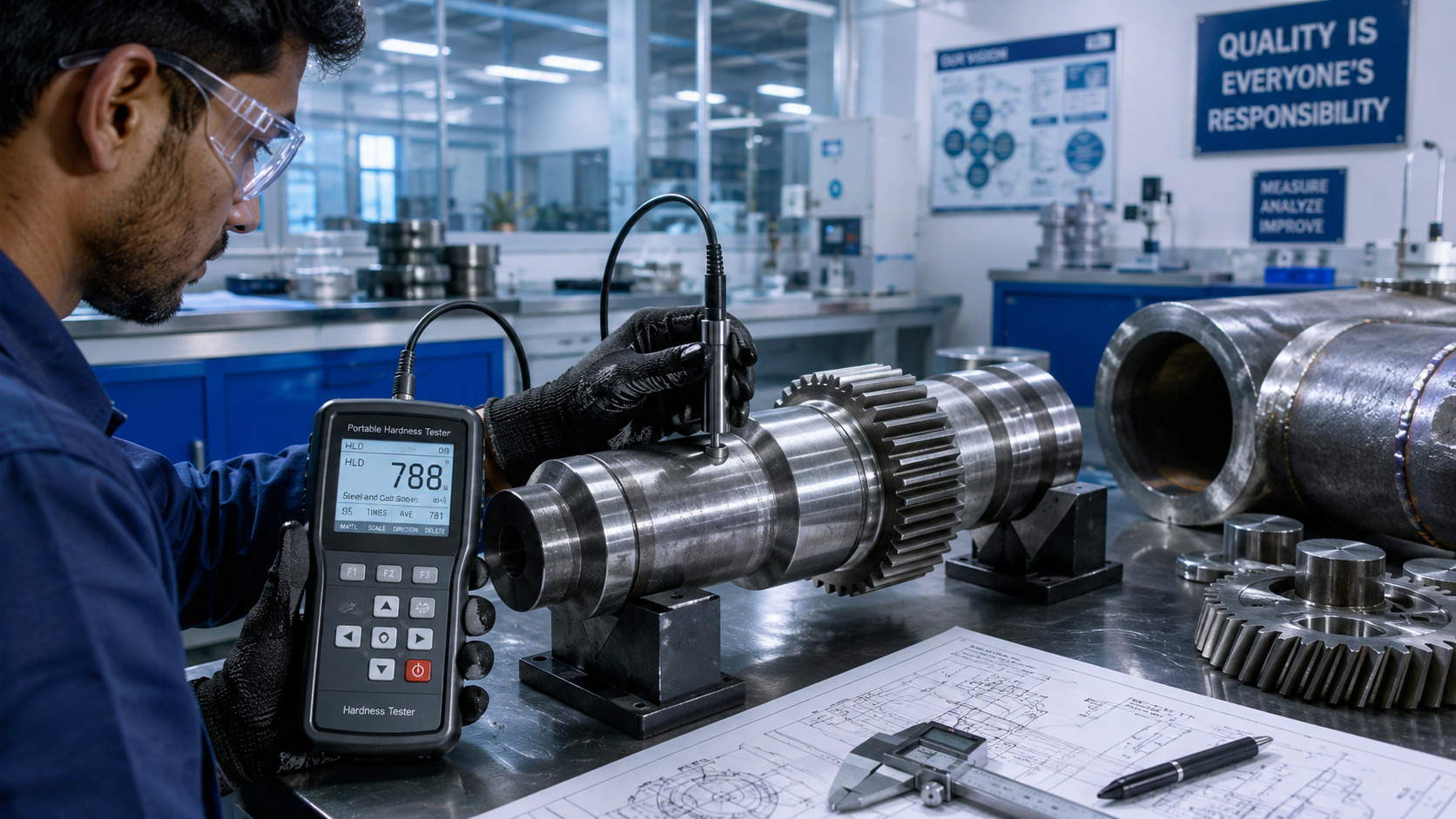
A portable hardness tester is a compact, handheld or battery-operated device that measures the hardness of a material on-site — without the need to cut, transport, or prepare a sample for a laboratory machine. It is particularly valuable when testing large structures, assembled components, installed machinery, or items that cannot be moved.
Unlike conventional hardness testers (Rockwell, Brinell, Vickers benchtop machines), portable testers are designed for field use. They deliver results in seconds and can convert readings across multiple hardness scales — including Rockwell (HRC, HRB), Brinell (HB), Vickers (HV), Leeb (HLD), and Shore (HS).
Why Is Portable Hardness Testing Important?
The ability to test hardness on-site has transformed quality control across Indian industries. Here is why more engineers and quality managers are investing in portable hardness testing machines:
- Test large workpieces (crankshafts, pressure vessels, structural steel beams) without disassembly
- Verify heat treatment results immediately after the process
- Inspect welds and heat-affected zones (HAZ) for compliance with PWHT standards
- Conduct incoming material inspection at the receiving dock — no lab required
- Reduce downtime by performing in-situ testing on installed equipment
- Meet quality and regulatory standards (ASTM, ISO, BIS) cost-effectively
Types of Portable Hardness Testers
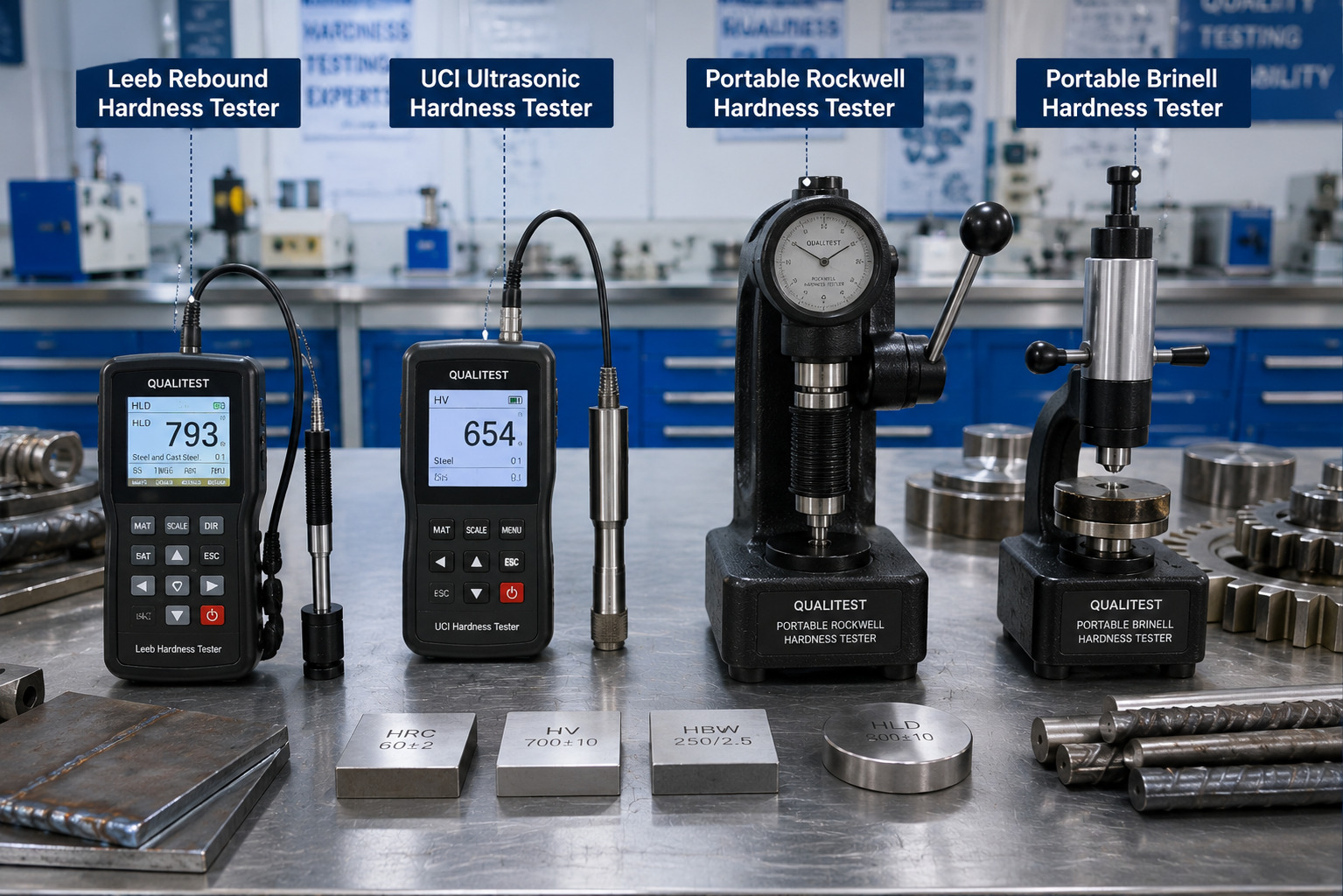
There are four principal testing methods used in portable hardness testers, each suited to different applications:
- Leeb Rebound (Dynamic) Hardness Tester
The Leeb method, developed in Switzerland in 1975, is the most widely used portable hardness testing principle. A spring-loaded impact body strikes the metal surface and bounces back. The ratio of rebound velocity to impact velocity is calculated as the Leeb Hardness Value (HLD), which is then automatically converted to Rockwell, Brinell, Vickers, or Shore values using material-specific conversion tables stored in the instrument.
Best For: Large forgings, castings, structural steel, in-situ testing of vessels and pipelines.
Standards: ASTM A956, ISO 16859
Advantage: Fast, non-destructive, supports interchangeable impact probes for different part geometries.
- UCI (Ultrasonic Contact Impedance) Hardness Tester
The UCI method uses an oscillating rod with a Vickers diamond tip. When pressed into the surface, the resonant frequency of the rod changes in proportion to the material’s hardness. UCI testers provide results in the Vickers scale and are particularly accurate on small, thin, or surface-hardened components where Leeb would give unreliable results.
Best For: Weld inspection, heat-treated surfaces, thin-walled components, heat-affected zones.
Standards: ASTM A1038, DIN 50159-1, ISO 16942
Advantage: Leaves virtually no visible indentation, ideal for precision-machined or finished surfaces.
- Portable Rockwell Hardness Tester
Portable Rockwell testers replicate the standard benchtop Rockwell test in a clamp-mounted package. A C-frame or magnetic base holds the indenter against the surface and applies the exact load cycle (preload + major load) used by benchtop Rockwell machines. This preserves direct compatibility with Rockwell scale values.
Best For: Production settings where fixture-based testing is practical, components where precise Rockwell values are required by specification.
Advantage: True Rockwell measurement — no conversion needed.
- Portable Brinell Hardness Tester
Portable Brinell testers apply a known load via a hardened steel or tungsten carbide ball, and the resulting indentation diameter is measured optically or electronically. This method is ideal for coarse-grained materials and heavy castings where other methods may be inaccurate.
Best For: Large castings, forgings, rough steel plates, and materials with heterogeneous grain structures.
Standards: ISO 6506, ASTM E10
Comparison: Which Portable Hardness Testing Method Should You Choose?
| Method | Best Material | Accuracy | Field Usability | Surface Finish Needed |
| Leeb (Rebound) | Castings, forgings, structural steel | Good | Excellent | Moderate (Ra ≤5μm) |
| UCI | Welds, thin sections, hardened surfaces | Very High | Good | Fine finish needed |
| Portable Rockwell | Production parts with fixture | High | Moderate | Smooth surface |
| Portable Brinell | Coarse castings, heavy forgings | Good | Moderate | Prepared surface |
Key Industries Using Portable Hardness Testers in India
- Steel & Metal Manufacturing: Incoming raw material inspection, QC of rolled sections, verification of heat treatment
- Automotive: Checking crankshafts, gears, axles, and engine components for hardness compliance
- Oil & Gas / Petrochemical: NACE MR0175 sour-service compliance, pipeline weld inspection, pressure vessel PWHT verification
- Construction & Civil Engineering: Reinforcement steel hardness verification, structural steel inspection
- Aerospace & Defence: Material certification for critical components
- Power Generation: Turbine blade and boiler component inspection
- Foundries: Post-casting and post-heat-treatment hardness verification of iron and steel castings
How to Use a Portable Hardness Tester — Step by Step
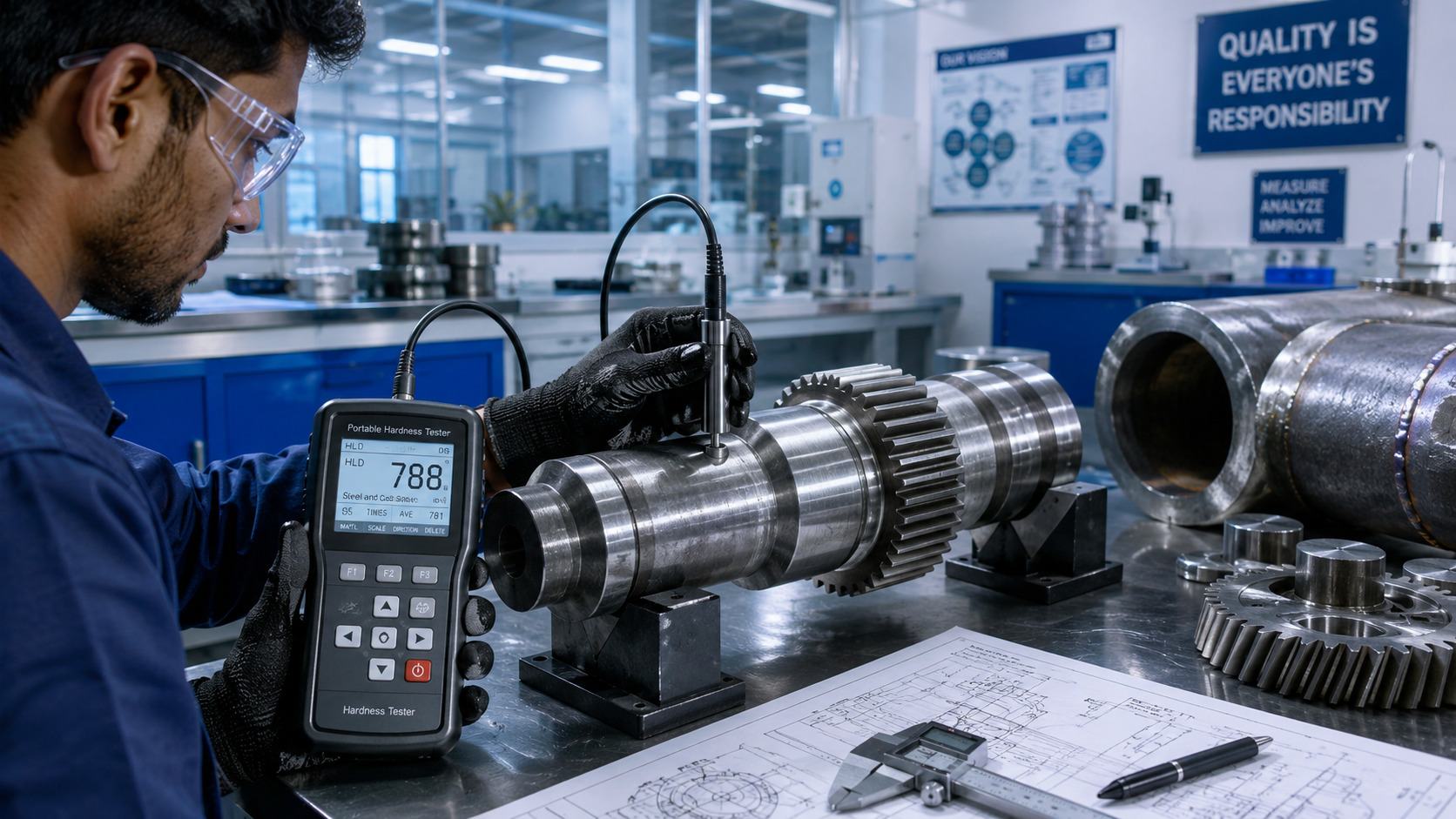
- Prepare the surface: Clean and smooth the test area (remove rust, scale, paint). Surface roughness matters — most Leeb testers require Ra ≤ 5μm.
- Calibrate: Always calibrate against a certified reference block before testing — especially for Leeb devices.
- Set material group and probe direction: Select the correct material group (steel, cast iron, aluminium, etc.) and orient the probe correctly relative to gravity (for Leeb testers).
- Apply the probe: Hold the probe perpendicular to the test surface. Apply steady, even pressure.
- Take multiple readings: Take 3–5 readings at each point. Discard outliers. Average the remaining values for a representative result.
- Record and export: Modern digital portable hardness testers store results and export via USB or Bluetooth for report generation.
How to Choose the Right Portable Hardness Tester in India
When evaluating a portable hardness testing machine, consider:
- Material type: Steel, aluminium, copper, cast iron, or polymers each respond differently to testing methods.
- Component size and geometry: Very small parts or thin sections require UCI; large structures are ideal for Leeb.
- Required accuracy and standards: Specify the applicable standard (ASTM A956, ASTM A1038, ISO) to your supplier.
- Surface condition: Finished machined surfaces are suitable for UCI; rough surfaces need grinding/polishing first.
- Data management: Look for USB/Bluetooth connectivity, built-in memory, and PC software for traceability.
- After-sales support: Calibration services, spare impact bodies, and local technical support are critical for long-term reliability.
Portable Hardness Tester Price in India
Portable hardness tester prices in India vary significantly based on method, brand, and features. As a general guide:
- Entry-level Leeb testers: ₹10,000 – ₹35,000
- Mid-range digital portable testers (Leeb with multi-probe): ₹65,000 – ₹1,50,000
- Advanced UCI or dual-mode (Leeb + UCI) testers: ₹2,00,000 – ₹5,50,000
- Branded international models (Proceq Equotip, Fischer Sonodur): ₹3,00,000 – ₹12,00,000+
For Indian manufacturers and quality labs seeking a balance of accuracy and affordability, UMI Universal offers cost-effective hardness testing solutions with full manufacturer support from our Pune facility.
Frequently Asked Questions (FAQs)
Q: What is the most accurate portable hardness tester?
A: For fine surfaces and weld inspection, UCI-based portable testers offer the highest accuracy. For large components and castings, advanced Leeb testers with calibrated probes are typically the most accurate field option.
Q: Can a portable hardness tester replace a benchtop tester?
A: For field use, incoming inspection, and in-situ testing of large parts, yes. For very small samples, extremely thin sections, or certification-level accuracy requirements, benchtop testing may still be preferred or required by specification.
Q: What is Leeb hardness testing?
A: Leeb hardness testing is a non-destructive portable testing method where the ratio of a metal ball’s rebound speed to impact speed is used to calculate hardness. Results are expressed as HLD values and automatically converted to Rockwell, Brinell, Vickers, or Shore values.
Q: How much does a portable hardness tester cost in India?
A: Prices range from ₹10,000 for basic models to over ₹12 lakhs for advanced branded systems. For Indian industry needs, mid-range options in the ₹65,000–₹2,00,000 range typically offer the best accuracy-to-cost ratio.
Q: What hardness scales can a portable tester measure?
A: Modern digital portable hardness testers can display values in Rockwell C (HRC), Rockwell B (HRB), Brinell (HB), Vickers (HV), Shore (HS), and Leeb (HLD) scales — often with automatic conversion between scales.
Conclusion
A portable hardness tester is an indispensable tool for any quality-conscious Indian manufacturer, foundry, steel plant, or testing laboratory. By bringing accurate hardness measurement directly to the workpiece — eliminating the delays and costs of benchtop lab testing — these instruments deliver faster quality decisions and stronger regulatory compliance.
UMI Universal, based in Pune, India, manufactures and supplies a complete range of hardness testing equipment for Indian industry. Whether you need a portable Leeb tester for a steel plant or a UCI tester for weld inspection, our team is ready to help you find the right solution.
Contact UMI Universal today: +91-2025204168 | sales@universal-motion.com | Warje, Pune 411052