
Automatic Compression Testing Machine: CTM Machine Types, Working Principle, IS 516 Concrete Cube Test Procedure, Pace Rate Control & Complete Buyer’s Guide — India 2026
Every concrete structure — a residential flat, a flyover, a dam, or an airport runway — is only as reliable as the concrete it is built from. And the most fundamental way to verify that reliability is the concrete cube compression test. The machine that performs this test — the Compression Testing Machine (CTM) — is the most widely used piece of testing equipment in India’s construction industry.
But not all CTMs are the same. A basic hand-operated machine and a fully automatic compression testing machine with a servo-controlled pace rate can cost ten times more — and deliver results with fundamentally different accuracy and operator dependence. Choosing the wrong machine leads to poor test repeatability, non-compliance with IS 14858 and IS 516, failed audits, and ultimately unsafe concrete approval decisions.
This guide covers everything you need to know: how the CTM machine works, the IS 516 concrete cube test procedure step by step, how pace rate control affects your results, a full comparison of manual vs semi-automatic vs fully automatic CTMs, competitor analysis, price guide, and how to choose the right machine for your lab.
UMI Universal Motion manufactures a complete range of compression testing machines and civil engineering lab equipment from Pimpri-Chinchwad, Pune, with 23+ years of experience supplying construction labs across India and internationally.
| IS 516 Indian standard — concrete cube test | IS 14858 Indian standard — CTM machine compliance | 0.2–1.0 kN/s Correct pace rate for concrete (IS 516) | 23 yrs UMI Universal manufacturing experience |
1. What Is a Compression Testing Machine (CTM)?
A Compression Testing Machine (CTM) is a hydraulic or mechanical testing instrument designed to apply a controlled compressive force to a specimen — typically a concrete cube or cylinder — until it fractures. The machine records the maximum force at failure, from which the compressive strength in N/mm² (MPa) is calculated.
CTM machines are used to verify that concrete mixed and poured on construction sites meets the design strength specified by the structural engineer — for example, M25 grade concrete must achieve a minimum compressive strength of 25 N/mm² at 28 days. Without this verification, no safety-critical structure should be approved.
The CTM machine tests not only concrete but also:
- Cement mortar cubes (cement quality control per IS 269, IS 1489)
- Bricks — compressive strength per IS 3495
- Paving blocks, kerb stones — IS 15658
- Rock core specimens — core compression testing
- Fly ash bricks, AAC blocks — alternative material qualification
- Concrete cylinders — ASTM C39, BS 1881 (diameter × 2 height ratio)
2. How the CTM Machine Works — Working Principle
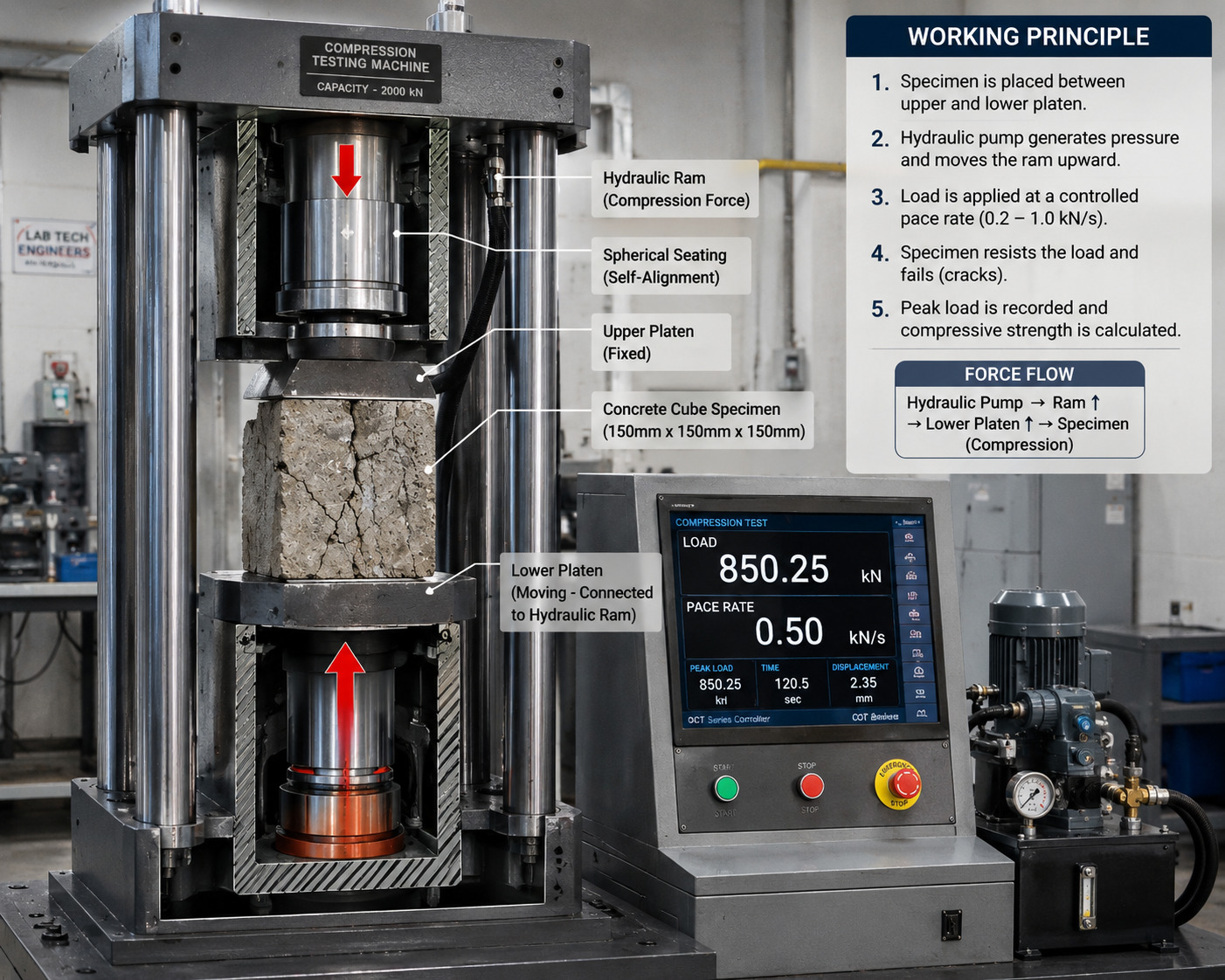
The working principle of a compression testing machine is straightforward. A hydraulic ram, driven by a motor-pump unit, applies an upward force through a lower platen to the test specimen placed on it. The specimen is sandwiched between the lower platen (moving) and the upper platen (fixed, with a spherical seating). As pressure builds, the specimen resists until it fractures. Here is the complete sequence:
Step 1 — Specimen Preparation and Curing
Concrete cube specimens (100mm × 100mm × 100mm or 150mm × 150mm × 150mm) are cast in steel moulds, compacted using a vibrating table or tamping rod per IS 516, and stored in water at 27°C ± 2°C until the test date. Standard test ages: 7 days (indicative) and 28 days (acceptance). The cube surfaces must be smooth and parallel — use a capping compound or grinding if needed.
Step 2 — Machine Preparation and Zeroing
Switch on the hydraulic pump and allow the oil to reach operating temperature (2–3 minutes). Verify that the platens are clean, flat, and free of debris. On digital machines, zero the load display. Centre the specimen on the lower platen, ensuring the loaded faces are perpendicular to the direction of casting (not the trowelled face).
Step 3 — Loading at Controlled Pace Rate
Apply load at a constant pace rate of 0.2 to 1.0 kN/s (IS 516 requirement). This is the most critical step — an incorrect loading rate gives invalid results. On a manual machine, the operator controls the pace rate by watching the load display. On an automatic CTM, the machine maintains the set pace rate automatically through servo or PID control, removing operator error entirely.
Step 4 — Specimen Fracture and Peak Load Recording
The specimen fractures suddenly under increasing compression. At fracture, the hydraulic pressure drops sharply. The peak load (in kN) is recorded — on analogue machines via a maximum-hold pointer, on digital machines via electronic peak hold. The machine stops automatically on fully automatic models.
Step 5 — Compressive Strength Calculation
Compressive strength is calculated as:
| Compressive Strength Formula (IS 516) f’c = P ÷ A Where: P = Maximum load at failure (N) | A = Cross-section area of cube (mm²) For 150mm cube: A = 150 × 150 = 22,500 mm² For 100mm cube: A = 100 × 100 = 10,000 mm² Example: 150mm cube fractures at 540 kN → f’c = 540,000 ÷ 22,500 = 24.0 N/mm² (M25 — PASS ✓) |
Step 6 — Result Reporting
Report the average of three cube specimens tested at the same age as the compressive strength for that batch. On automatic CTMs with PC software, a test certificate including specimen ID, cast date, test date, age, peak load, and compressive strength in N/mm² and kg/cm² is generated automatically and saved to the database.
3. IS 516 Concrete Cube Test Procedure — Step by Step
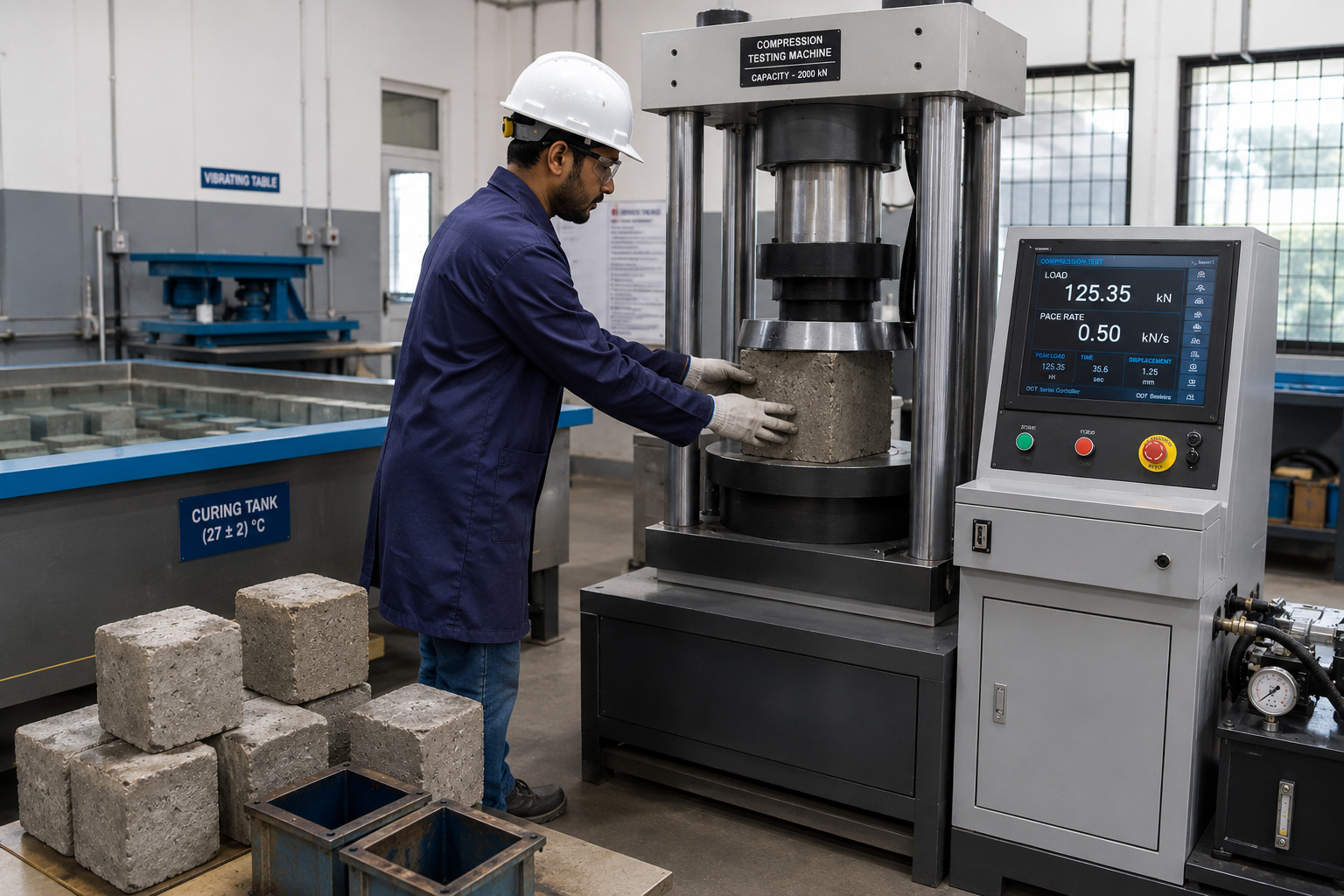
IS 516 (Methods of Tests for Strength of Concrete) is the governing Indian standard for concrete cube testing. Below is the complete IS 516 cube test procedure — the most searched procedure by civil engineers in India and a key content gap no competitor has fully covered.
| Step | IS 516 Requirement | Why It Matters |
| 1. Sampling | Take sample from middle of concrete delivery — not first or last portion. Sample minimum 0.02 m³ per IS 1199 | Ensures representative mix — not a segregated or over-compacted portion |
| 2. Mould preparation | Clean, oil-lubricated 150mm × 150mm × 150mm steel cube moulds (or 100mm for smaller aggregate). IS 10086 mould spec. | Incorrect mould dimensions or rough surface give invalid cube dimensions |
| 3. Filling & compaction | Fill in 3 layers, each tamped 35 times with 16mm dia steel rod (manual) or vibrated on vibrating table (mechanical) | Under-compaction → porous cube → falsely low strength. Over-vibration → segregation |
| 4. Surface finishing | Strike off excess concrete flush with top of mould. Cover with wet hessian or polythene for 24 hours. | Prevent surface evaporation and plastic shrinkage cracking |
| 5. Demoulding | Remove from mould at 24 ± 0.5 hours after casting. Do not demould earlier for low-strength mixes. | Early demoulding damages corners and edges — invalid specimen |
| 6. Curing in water | Immerse immediately in clean water at 27°C ± 2°C. Cure until test date (7 days / 28 days). | Water temperature critical — 1°C variation = ~2% strength variation over 28 days |
| 7. Specimen preparation before test | Remove from water, wipe surface dry. Check dimensions: 150 ± 1mm. Check parallelism: faces flat within 0.05mm. | Out-of-spec specimens give erratic results — reject and retest |
| 8. Placement in CTM | Place cube so the faces NOT trowelled are in contact with platens (i.e., cast faces contact platens). | Trowelled face has different surface hardness — placing it in contact distorts results |
| 9. Loading rate | Apply load at 0.2 to 1.0 kN/s continuously (not intermittently). Do not adjust pace during loading. | Incorrect pace rate is the most common cause of non-conforming cube test results |
| 10. Record failure load | Record maximum load (P) and note the type of fracture (satisfactory or unsatisfactory per IS 516 Fig. 1). | Unsatisfactory fracture mode (corner split, vertical crack) may indicate mould or platen problems |
| 11. Calculate & report | f’c = P ÷ A (N/mm²). Report average of 3 cubes from same batch. Note if any individual cube deviates by >15% from average. | >15% deviation between cubes from same batch: investigate cause before accepting result |
| Common IS 516 Mistakes That Invalidate Cube Test Results: 1. Loading the trowelled face (instead of cast face) against the platen — gives 5–10% higher false result 2. Using the wrong pace rate — too fast → higher apparent strength; too slow → lower apparent strength 3. Curing at wrong temperature — Indian labs often miss the 27°C ± 2°C requirement in summer 4. Demoulding too early — < 18 hours for M20 or below causes surface damage 5. Not verifying cube dimensions — accepting 148mm cubes as 150mm gives 4% area error in strength calculation |
4. Concrete Grade Acceptance Criteria — M10 to M50
Every concrete grade has a characteristic compressive strength (fck) that it must achieve at 28 days. The table below gives the minimum compressive strength requirement per IS 456:2000 and the corresponding minimum failure load for standard cube sizes — this is exactly the number your CTM must read or exceed for cube acceptance.
| Grade | fck (MPa) | 28-Day Min. Strength | Min. Load 100mm Cube | Min. Load 150mm Cube | Typical Application |
| M10 | 10 | >= 10 N/mm2 | 3.16 kN | 7.13 kN | Plain concrete, mass concrete, levelling courses |
| M15 | 15 | >= 15 N/mm2 | 4.74 kN | 10.69 kN | Plain concrete, residential slabs (non-structural) |
| M20 | 20 | >= 20 N/mm2 | 6.32 kN | 14.24 kN | RCC slabs, beams, columns — general construction |
| M25 | 25 | >= 25 N/mm2 | 7.91 kN | 17.82 kN | RCC frames, bridges, water-retaining structures |
| M30 | 30 | >= 30 N/mm2 | 9.49 kN | 21.38 kN | High-strength RCC, pre-stressed, heavy loading |
| M35 | 35 | >= 35 N/mm2 | 11.07 kN | 24.95 kN | Bridges, piles, industrial floors |
| M40 | 40 | >= 40 N/mm2 | 12.65 kN | 28.50 kN | High-rise buildings, long-span bridges, prestressed |
| M50 | 50 | >= 50 N/mm2 | 15.82 kN | 35.65 kN | Special structures, marine works, high-performance concrete |
Note: IS 456 acceptance criteria: individual cube must not be below fck − 4 N/mm² (for M20 and above). Mean of 4 consecutive test results must be ≥ fck + 0.825 × standard deviation. The CTM machine must have sufficient resolution to distinguish results at this level — minimum ±1% accuracy (IS 14858).
5. Pace Rate Control — Why It Is the Most Critical CTM Feature
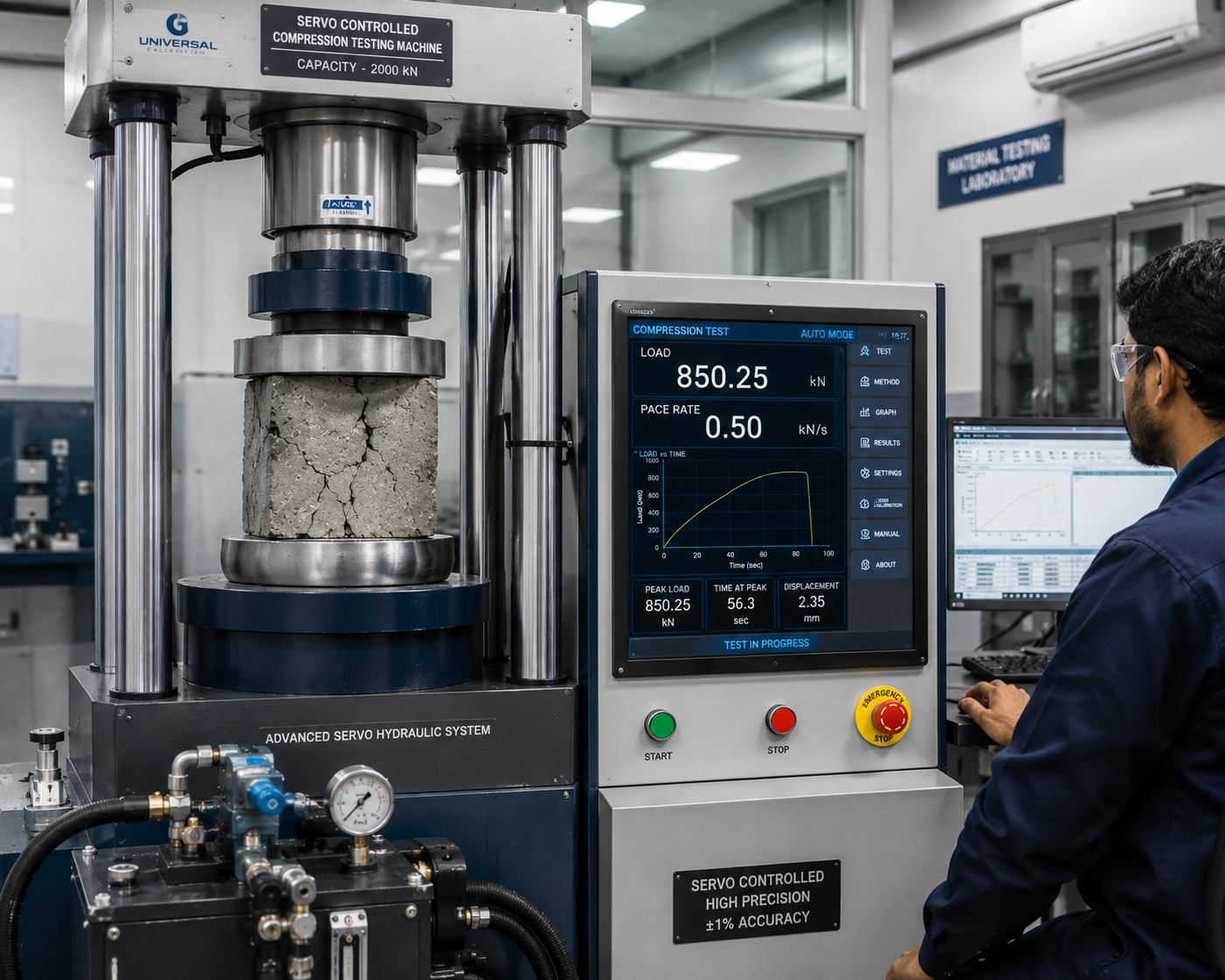
Of all the variables in a concrete cube test, pace rate (loading rate) has the greatest impact on the result — and is the most commonly misunderstood and ignored. This section covers what no competitor’s content explains in depth.
5.1 What Is Pace Rate?
Pace rate is the speed at which load is applied to the specimen, expressed in kN per second (kN/s) or N/mm² per second. IS 516 specifies a pace rate of 0.2 to 1.0 kN/s for standard concrete cube testing. BS 1881 specifies 0.2 to 0.4 N/mm²/s. ASTM C39 specifies 0.25 ± 0.05 MPa/s.
5.2 How Pace Rate Affects Your Results
| Loading Rate | Effect on Result | Risk |
| Too slow (< 0.1 kN/s) | Allows creep and stress relaxation — specimen appears weaker | Falsely low compressive strength — may reject acceptable concrete |
| Correct (0.2–1.0 kN/s per IS 516) | True static compressive strength — reproducible and standard-compliant | Results valid and comparable across labs and test dates |
| Too fast (> 1.5 kN/s) | Dynamic loading effect — specimen appears stronger | Falsely high strength — may approve under-strength concrete → safety risk |
| Intermittent loading (pauses) | Stress relaxation during pauses — inconsistent energy input | Highly variable results — test is non-standard and invalid |
5.3 Manual vs Automatic Pace Rate Control
This is the fundamental difference between machine types that buyers must understand:
| Pace Rate Control Type | How It Works | Accuracy | Best For |
| Manual (hand-operated valve) | Operator turns a hand valve while watching load display — judging speed by eye and feel | ±30–50% typical — highly operator-dependent | Basic site QC, training labs, cost-sensitive buyers |
| Semi-Automatic (pace rate indicator) | Digital indicator shows kN/s in real time — operator adjusts valve to keep within IS 516 range | ±10–20% — operator still needed but guided | Most production labs, IS 516 compliance with trained operators |
| Automatic (PID-controlled servo valve) | Microprocessor reads load rate 100× per second, automatically adjusts servo valve to maintain set pace rate without operator input | ±2–3% — machine-maintained, fully repeatable | NABL labs, high-volume QC, no skilled operator required |
| Fully Automatic Servo (closed-loop) | Full electro-hydraulic servo control — load rate, displacement rate, or strain rate controlled with closed-loop feedback. PC software control. | ±1% — research grade | R&D, NABL, sophisticated QC labs, ASTM C39 export contracts |
| UMI Universal’s Recommendation on Pace Rate: For any lab doing IS 516 testing for concrete acceptance (M20, M25, M30) on construction projects — a Semi-Automatic CTM with pace rate indicator is the minimum standard. For NABL-accredited labs, government testing labs, or high-volume QC where operator variability is a concern — a Fully Automatic CTM with PID-controlled servo is the correct specification. A manual CTM with only a pressure gauge and hand valve does NOT reliably maintain pace rate within IS 516 limits — use only for training or indicative testing. |
6. Types of Compression Testing Machines
6.1 Hand-Operated / Manual CTM
The simplest and oldest type. A hand-operated hydraulic pump applies pressure through a two-speed plunger. The operator reads load from a Bourdon tube pressure gauge calibrated in kN, with a maximum-hold pointer. No electric motor. Suitable for: basic site testing, teaching, and locations without electric supply.
- Capacity: 500 kN, 1000 kN, 2000 kN
- Standards: IS 516, IS 14858 (±2% accuracy)
- Price range: ₹30,000 – ₹1,20,000
- Limitation: Cannot reliably control pace rate. Not suitable for IS 14858-compliant acceptance testing.
6.2 Digital CTM — Semi-Automatic
Electrically operated hydraulic pump with digital load indicator. Operator controls pace rate manually using a motorized flow control valve, guided by real-time kN/s display on the controller. Results displayed digitally — peak load in kN, compressive strength in N/mm² and kg/cm² calculated automatically.
- Display: 7-inch touch screen or LCD controller
- Data output: USB, RS-232, printer
- Standards: IS 14858, IS 516, BS 1881
- Price range: ₹1,20,000 – ₹4,00,000
- Most popular model in India — best value for standard construction QC labs
6.3 Fully Automatic CTM — PID/Servo Controlled
The pace rate is set once in the software and maintained automatically by the machine throughout the test — no operator adjustment required. The electro-hydraulic system uses a PID controller and proportional servo valve to regulate oil flow to the hydraulic ram at exactly the programmed kN/s rate. The machine auto-stops at specimen failure, records the peak load, calculates and displays the result, and saves the test certificate.
- Pace rate: Programmable 0.1–40 kN/s, maintained ±2% automatically
- Software: Windows PC with test database, PDF/Excel reports, batch management
- Standards: IS 14858, IS 516, BS 1881, ASTM C39, EN 12390-4
- Capacity: 500 kN, 1000 kN, 2000 kN, 3000 kN
- Price range: ₹3,00,000 – ₹12,00,000
- Best for: NABL labs, government testing labs, high-volume QC, export contracts
6.4 Servo Hydraulic CTM — Research Grade
Closed-loop servo-hydraulic control with load cell (not pressure gauge) for highest accuracy measurement. Can run load-controlled, displacement-controlled, or strain-controlled compression tests. Used for research, fracture mechanics of concrete, and advanced material characterization.
- Accuracy: ±0.5% of indicated load (exceeds IS 14858 Grade 1)
- Price range: ₹12,00,000 – ₹50,00,000+
- Best for: IITs, CSIR labs, NCCBM, advanced R&D
6.5 Multi-Function CTM — Compression + Flexural
A standard CTM frame with an additional flexural beam testing attachment for testing concrete beam specimens in three-point or four-point bending (flexural strength / modulus of rupture, IS 516 Part 2). One machine handles both compression cube tests and beam flexure tests — preferred by labs that test both.
- Price premium: +₹30,000 – ₹80,000 over standard CTM for flexural attachment
7. Key Components of an Automatic Compression Testing Machine
| Load Frame Fully welded steel frame — plate model (high rigidity, preferred) or pillar model. Must withstand millions of compression cycles without fatigue. Frame stiffness determines accuracy — flexible frames release stored energy at fracture, giving incorrect peak load. Look for: thick steel plates, full-penetration welds, ground and parallel platens. | Hydraulic Ram & Pump Unit Single-acting hydraulic cylinder with chrome-plated hard ram. High-pressure pump unit with electric motor (1–3 HP typical), relief valve, oil reservoir, and flow control system. Separate power pack unit connected by high-pressure hose. Oil type: ISO 46 hydraulic oil. Filter replacement: every 500 operating hours. | |
| Platens — Upper & Lower Hardened and ground steel platens (60 HRC surface). Upper platen has a spherical (ball) seating allowing self-alignment to compensate for non-parallel cube faces — mandatory per IS 14858. Lower platen mounted directly on ram. Platen size: minimum 150mm × 150mm for standard cubes. Spacer plates provided for 100mm cubes. | Controller / Touch-Screen HMI For automatic CTMs: 7-inch (or larger) colour touch screen with test menu. Set pace rate, sample size, and test type. Real-time display of load (kN), stress (N/mm², kg/cm²), and pace rate (kN/s) with bar-graph indicator. Peak hold, auto-stop, and result display on fracture. USB and RS-232 data ports. | |
| Load Measurement System Analogue: Bourdon-tube pressure gauge calibrated in kN against certified proving ring (NCCBM or NPL). Accuracy ±2%. Digital: strain-gauge load cell or pressure transducer feeding microprocessor controller. Accuracy ±1% (IS 14858 Class 1). For servo machines: high-precision load cell with ±0.5% accuracy. | Safety Features Safety door enclosure (on automatic models) prevents operator exposure to flying cube fragments. Overload protection: machine cuts off motor if load exceeds 110% of rated capacity. Relief valve prevents hydraulic over-pressure. Emergency stop button on control panel. Relay prevents motor restart after power failure — essential for IS 14858 compliance. | |
| PC Software (Auto Models) Windows-based software for fully automatic CTMs: set sample details (ID, mix design, cast date, grade), program pace rate and auto-stop, monitor test live with load-time graph, auto-calculate compressive strength, generate test certificate (PDF/Excel), store in searchable database with project and sample management. | Spacers & Accessories Spacer plates for 100mm cube and cylinder testing. Flexural beam testing attachment (optional). Cylinder compression caps (rubber or sulphur capping compound). Cube dimension checking gauge. Calibration proving ring or load cell reference. Cube moulds (IS 10086) — 100mm and 150mm sizes, steel or plastic. | |
8. Competitor Analysis — Compression Testing Machine Market India 2026
Research conducted May 2026 across Google search results, IndiaMart listings, and competitor websites for the keywords ‘automatic compression testing machine’ and ‘CTM machine India’. Here is the competitive landscape UMI Universal faces — and where the strategic ranking opportunities lie.
| # | Competitor & Location | Ranking Strength | Content / SEO Gap | UMI Opportunity |
| 1 | HEICO (heicoin.com) Delhi NCR | Ranks P1 for ‘servo CTM India’. Recent blog (Mar 2026) on CTM types — good technical depth. Strong IndiaMart presence. Servo machines well-documented. | Blog covers types but NOT IS 516 procedure, NOT pace rate impact on results, NOT grade-wise acceptance criteria — UMI’s article fills this gap completely. | UMI targets informational keywords (IS 516, pace rate control, M25 cube test) where HEICO has no content. |
| 2 | Vertex Instruments (vertexinstruments.com) Pune | Strong for ‘semi-automatic CTM’ — clear IS 14858/IS 516 compliance messaging. Good product pages. Pune location (same as UMI). | Zero blog content on CTM. No IS 516 test procedure. No buyer guide. No price transparency. Purely product catalogue. | UMI’s blog content will dominate informational CTM searches that Vertex cannot compete on (no content). |
| 3 | Aimil Ltd (aimil.com) Delhi | Best existing CTM blog in India — ‘What is CTM Machine’. Good SEO. Government and NABL clientele. | Their blog covers machine variants only — no IS 516 procedure, no pace rate science, no concrete grade table, no competitor comparison. Published April 2024 — outdated. | UMI’s 2026 article is more comprehensive, more current, includes IS 516 steps + grade table + pace rate guide — will outrank for long-tail searches. |
| 4 | AMV Scientific (amvscientific.in) Delhi NCR | Ranks for ‘automatic compression testing machine manufacturer New Delhi’. Basic product pages. | Thin content — mostly product specs. No blog. No IS standards explanation. No buyer guidance. Poor mobile experience. | UMI’s comprehensive guide with IS 516 + pace rate + buyer guide captures buyers that AMV’s thin pages lose. |
| 5 | Lokpal Industries (lokpalindustries.net) Delhi | IndiaMart TrustSEAL, ranks for ‘cube testing machine India’. Good catalog breadth. | Product catalog only — zero educational or blog content. No IS 516, no pace rate, no grade acceptance criteria. | UMI’s content-first approach will consistently outrank product-catalog-only competitors for informational searches. |
| Key SEO Content Gap — UMI’s Strategic Advantage: Research confirms: NO Indian CTM manufacturer has published a complete article covering (1) IS 516 cube test procedure step-by-step, (2) pace rate science and its impact on results, AND (3) concrete grade acceptance criteria (M10–M50) — all in one article. This article fills that gap entirely. Civil engineers and QC managers searching for any of these three topics in combination will find UMI Universal’s article — and no competitor’s content. Internal linking: This article should link to UMI’s civil engineering lab equipment page, UTM blog, and tensile testing blog — building the complete civil engineering testing content cluster. |
| Need a Compression Testing Machine? Get a Free Quote — UMI Universal Manual, Semi-Automatic & Fully Automatic CTMs — IS 14858 & IS 516 Compliant — 500kN to 3000kN — Pune Manufacturer ☎ +91-2025204168 | 🌐 universal-motion.com/contact-us/ [ Request Free Quote + Technical Datasheet ] |
9. CTM Machine Standards — IS 14858, IS 516, BS 1881, ASTM C39
| Standard | Scope | Key Requirements for CTM Machine |
| IS 14858:2000 | Verification of compression testing machines — India (aligned with ISO 7500-2) | Accuracy ±1% (Class 1) or ±2% (Class 2). Load measurement system verification. Platen flatness ≤0.05mm. Spherical seating. Pace rate maintained ±5%. Annual re-verification by NCCBM/NABL lab. |
| IS 516:1959 (Reaffirmed 2004) | Methods of Tests for Strength of Concrete — cube test procedure | Test specimen: 150mm or 100mm cubes. Curing at 27°C ± 2°C. Pace rate: 0.2–1.0 kN/s. Load on cast faces. Report average of 3 cubes. |
| IS 456:2000 | Plain and Reinforced Concrete Code of Practice — acceptance criteria | Characteristic strength fck at 28 days. Acceptance: mean of 4 results ≥ fck + 0.825σ AND no individual result < fck − 4 MPa (for M20+). |
| BS 1881-116 | Testing Concrete — Compressive Strength — UK standard | 0.2–0.4 N/mm²/s pace rate (slightly tighter than IS 516). Used for export contracts to UK, Gulf, and Commonwealth countries. |
| ASTM C39 | Standard Test Method for Compressive Strength of Cylindrical Concrete Specimens | For cylinder specimens (100×200mm or 150×300mm). Pace rate 0.25 ± 0.05 MPa/s. Required for US, Canada, and some Middle East export contracts. |
| EN 12390-4 | Testing Hardened Concrete — Compressive Strength Testing Machines — European Standard | Machine verification aligned with ISO 7500-2. Accuracy ±1%. Required for CE-marked construction products exported to EU. |
| NCCBM Calibration | National Council for Cement and Building Materials — calibration body for CTMs in India | CTM machines in cement testing labs must be calibrated by NCCBM or NABL-accredited lab. Certificate must accompany machine for compliance. |
10. Industry Applications — Who Uses Compression Testing Machines?
| Sector | What Is Tested | CTM Specification | Standard |
| Construction & RCC | Concrete cubes — all M-grades, site QC | 500kN – 2000kN digital or auto CTM | IS 516, IS 456 |
| Ready Mix Concrete (RMC) | High-volume cube testing — 50–200 cubes/day | Auto CTM with PC software, database, auto-reporting | IS 4926, IS 516 |
| Cement Manufacturers | Cement mortar cubes (50mm) — strength at 3, 7, 28 days | Specialised small CTM (0–50kN) per IS 4031 | IS 4031, IS 269 |
| Infrastructure / Bridges | High-strength concrete M40–M60, pre-stressed | 1000–3000kN auto CTM, ASTM C39 / IS 516 | IS 456, IRC 112 |
| Precast Concrete Industry | Hollow blocks, paving, sleepers, pipe sections | 1000kN CTM with spacers for various specimen sizes | IS 15658, IS 458 |
| Government PWD / NHAI Labs | Concrete QC for roads, flyovers, dams | NABL-accredited auto CTM with calibration cert. | IS 516, IS 456 |
| Brick Manufacturers | Compressive strength of bricks, fly ash bricks | 500kN CTM with brick testing platens | IS 3495, IS 12894 |
| Engineering Colleges (Civil) | Teaching, research, student practicals | 1000kN digital CTM — affordable, IS 516 compliant | IS 516 |
| NABL-Accredited Test Labs | Third-party independent concrete testing | Fully automatic CTM, NCCBM calibrated, PC software | IS 14858, IS 516 |
| Export-Oriented Construction | Projects in Gulf, Africa, SE Asia, Europe | CTM with ASTM C39 / BS 1881 / EN 12390 compliance | ASTM C39, BS 1881 |
UMI Universal Motion supplies compression testing machines to all the above sectors from our Pune facility. We also supply complete civil engineering laboratory testing equipment packages including concrete cube moulds, vibrating tables, curing tanks, slump cone sets, and aggregate testing equipment. See also our related guides: Tensile Testing Machine Guide and Universal Testing Machine Price in India 2026.
11. How to Choose the Right Compression Testing Machine
Step 1 — Determine Your Required Capacity
Choose capacity based on the highest-grade concrete you will test and the cube size. For M50 concrete (150mm cubes): maximum expected load = 50 N/mm² × 22,500 mm² = 1,125 kN. Add 20% safety margin → specify a 1500kN or 2000kN machine. For standard M25 construction concrete: 1000kN is sufficient for 150mm cubes. For cement mortar cubes (50mm): a specialised 50kN machine is required.
Step 2 — Choose the Right Automation Level
Consider: (a) Volume of tests per day — high volume (50+ cubes/day) demands automatic pace rate. (b) Operator skill level — unskilled operators need automatic machines. (c) NABL or ISO certification requirement — requires automatic CTM with calibration certificate. (d) Budget — semi-automatic is the best value for most standard QC labs.
Step 3 — Verify Standards Compliance
Confirm machine meets IS 14858 (and ASTM C39 or BS 1881 if required). Ask for the NCCBM calibration certificate or confirm the machine is ready for NABL-accredited calibration. Check that the pace rate can be set and maintained within IS 516’s 0.2–1.0 kN/s range.
Step 4 — Evaluate Software and Reporting
For labs issuing test certificates to clients: PC software with automatic certificate generation is essential. Verify: results saved in Excel/PDF, searchable by project/date, printable certificate with client details, IS 456 acceptance check built in.
Step 5 — Check Accessory Package
Confirm what is included: spacer plates for 100mm cubes, spherical seating (mandatory per IS 14858), cube moulds (100mm and 150mm), and calibration proving ring certificate. Flexural attachment — required if you test beam specimens for IS 516 flexural strength.
Step 6 — Verify Manufacturer Credentials
Choose a manufacturer — not a trader — who manufactures in India, offers direct engineer support, has NCCBM-experienced calibration support, and stocks genuine spare parts. UMI Universal is a direct manufacturer in Pune — not a reseller — with 23+ years of track record in civil engineering lab equipment.
12. Compression Testing Machine Price in India (2026)
| CTM Machine Type | Capacity | Automation | Price Range (INR) | Best For |
| Hand-Operated Analogue CTM | 500–2000 kN | Manual | ₹30,000 – ₹1,20,000 | Site testing, teaching, basic QC, no power supply available |
| Digital Semi-Auto CTM | 500–2000 kN | Semi-Auto | ₹1,00,000 – ₹3,50,000 | Standard construction QC, IS 516, college labs |
| Auto CTM — Touch Screen | 500–2000 kN | Automatic (PID) | ₹2,50,000 – ₹7,00,000 | NABL labs, RMC plants, high-volume QC, IS 14858 Class 1 |
| Fully Auto CTM with PC Software | 1000–3000 kN | Full Auto + PC | ₹5,00,000 – ₹15,00,000 | Government labs, export QC, ASTM C39, EN 12390 |
| Servo Hydraulic CTM | 500–5000 kN | Servo Closed-Loop | ₹12,00,000 – ₹50,00,000 | R&D, IITs, CSIR, advanced materials research |
| CTM + Flexural Beam Attachment | 1000–2000 kN | Semi/Auto | Add ₹30,000–₹80,000 | Labs testing both cube compression and beam flexure |
| Cement Mortar CTM (50kN) | 50–100 kN | Digital | ₹60,000 – ₹2,00,000 | Cement manufacturers, cement quality labs, IS 4031 |
Note: All prices are indicative, subject to 18% GST, calibration certificate, cube moulds, accessories, and freight. Contact UMI Universal for an exact quotation with full specifications.
13. Frequently Asked Questions — Compression Testing Machine
Most searched questions from civil engineers, QC managers, and lab buyers across India.
Q: What is the correct pace rate for the concrete cube compression test as per IS 516?
A: IS 516 specifies a pace rate of 0.2 to 1.0 kN per second (kN/s) applied continuously without interruption until the specimen fails. This translates to approximately 4.5 to 22.5 MPa per minute for a 150mm cube. The pace rate must be maintained consistently — not increased at the end or paused during loading. A semi-automatic CTM with a pace rate indicator helps operators maintain this range; a fully automatic CTM maintains it without any operator intervention. Using the wrong pace rate is the most common cause of non-conforming and non-repeatable cube test results.
Q: What is the minimum compressive strength of M25 concrete at 28 days?
A: As per IS 456:2000, M25 grade concrete (characteristic compressive strength fck = 25 N/mm²) must satisfy both of the following acceptance criteria: (1) The mean of any group of 4 consecutive cube test results must be ≥ fck + 0.825 × standard deviation (and minimum fck + 3 N/mm² where σ is not established). (2) No individual test result (average of 3 cubes) must fall below fck − 4 N/mm² = 21 N/mm². For a 150mm cube, this means the minimum acceptable failure load is 21 N/mm² × 22,500 mm² = 472.5 kN. Using a 1000kN CTM machine, this reading should be clearly visible and measurable with ±1% accuracy.
Q: What is the difference between IS 14858 and IS 516?
A: IS 14858:2000 is the machine standard — it specifies how accurate the CTM machine must be (±1% for Class 1), how the load cell or pressure gauge must be calibrated, what the platen flatness requirements are, and how the machine must be verified. IS 516:1959 is the test method standard — it specifies how the concrete cube test must be performed: specimen size, curing conditions, pace rate, and how to calculate and report results. Both must be satisfied: IS 14858 ensures the machine is accurate, IS 516 ensures the test is performed correctly. A machine that meets IS 14858 but is operated at the wrong pace rate still gives invalid IS 516 results.
Q: Can the same CTM machine test both 150mm and 100mm cubes?
A: Yes. All standard CTM machines are supplied with spacer plates that reduce the clear platen opening to accommodate 100mm × 100mm × 100mm cubes. The 100mm cube is used when the maximum aggregate size is ≤ 20mm (versus 40mm for 150mm cubes). When calculating compressive strength for 100mm cubes, use the cross-section area of 10,000 mm² (versus 22,500 mm² for 150mm cubes). Some IS 456 acceptance criteria are stated for 150mm cubes — always verify which cube size your project specification requires. The IS 516 acceptance criteria (strength value) are the same for both sizes since the calculation normalises by area.
Q: How often must a CTM machine be calibrated in India?
A: Annual calibration is the standard requirement for most construction testing labs. For NABL-accredited labs, calibration must be done by a NABL-accredited calibration laboratory, and the calibration certificate must reference IS 14858 (or ISO 7500-2). For labs supplying test certificates to government projects (NHAI, PWD, CPWD), calibration by NCCBM (National Council for Cement and Building Materials) is preferred. Interim verification using a calibrated proving ring is recommended every 3–6 months or after any machine overload, relocation, or repair.
Q: What is the spherical seating in a CTM machine and why is it important?
A: The spherical (ball) seating is a self-aligning bearing fitted to the upper platen of the CTM. It allows the upper platen to tilt slightly (±1–2°) to compensate for non-parallel faces on the cube specimen. Without a spherical seating, a non-parallel cube would be loaded on only two edges instead of the full face — concentrating stress and giving a falsely low compressive strength result. IS 14858 mandates a correctly functioning spherical seating for all compliant CTM machines. Check that the spherical seating moves freely before every test — a seized or stuck seating gives the same result as having no seating at all.
Q: What is the IS 516 failure pattern and how do I identify a valid vs invalid fracture?
A: IS 516 defines acceptable (satisfactory) and unacceptable fracture patterns for concrete cubes. A satisfactory fracture is a double cone or hourglass fracture — the cube splits into two roughly symmetrical pyramid-shaped pieces, indicating uniform load distribution and a valid test. Unsatisfactory fractures include: vertical splitting on one side only (eccentric loading — usually platen or alignment problem), corner cracking only (platen flatness issue), or premature failure at very low load (soft cube, wet surface, or mould defect). IS 516 requires noting the fracture type on the test certificate. If an unsatisfactory fracture occurs, the result is still recorded but the type of fracture is flagged — the cube is not simply discarded.
Q: Does UMI Universal supply a calibration certificate with the CTM machine?
A: Yes. UMI Universal supplies all compression testing machines with a factory calibration certificate traceable to national standards (Bureau of Indian Standards / NPL / NCCBM). For NABL-accredited lab requirements, we can arrange calibration by a NABL-accredited calibration laboratory before dispatch — the cost of this calibration is quoted separately and depends on the machine capacity and calibration lab schedule. We also supply a calibrated proving ring as an optional accessory for in-house interim verification between scheduled calibrations. Contact our sales team to confirm calibration options for your specific lab requirements.
14. Conclusion — Choosing the Right Compression Testing Machine
The compression testing machine (CTM) is the cornerstone of every concrete quality control programme in India. Whether you are operating a site lab on a residential project, running a NABL-accredited test house, or managing quality for an infrastructure megaproject — the right machine, operated correctly per IS 516, gives you the data to approve or reject concrete with confidence.
The five key decisions in buying a CTM:
- Capacity: size to your highest concrete grade × cube face area + 20% margin
- Automation level: manual for training/site, semi-auto for standard QC, full-auto for NABL/high-volume
- Pace rate control: the single most important accuracy factor — never compromise on this
- Standards compliance: IS 14858 machine verification + IS 516 test method — both are mandatory
- Manufacturer: buy from a manufacturer with proven NCCBM calibration experience and post-sale service engineers
UMI Universal Motion manufactures a complete range of compression testing machines from our Pimpri-Chinchwad, Pune facility — from standard digital CTMs to fully automatic servo-controlled machines. We also supply complete civil engineering lab packages. Explore related products and guides:
- Civil Engineering Laboratory Equipment — compression testing, concrete, soil, aggregate
- Concrete Testing Equipment Range — cube moulds, slump, vibrating tables
- Universal Testing Machine (UTM) — tensile, compression, flexure testing
- Blog: Tensile Testing Machine — Complete Guide 2026
- Blog: Impact Testing Machine — Charpy vs Izod Guide
- Contact UMI Universal — free quote and technical consultation
| Get Your Free CTM Machine Quote — UMI Universal Manual • Digital • Semi-Automatic • Fully Automatic • IS 14858 • IS 516 • ASTM C39 • Pune Manufacturer • 23+ Years ☎ +91-2025204168 | 🌐 universal-motion.com/contact-us/ [ Request Free Quote + Technical Datasheet ] |