Brinell Hardness Tester: Complete Guide to HBW Testing, Standards & Selection (2026)
Introduction: Why the Brinell Hardness Tester Still Dominates After 125 Years
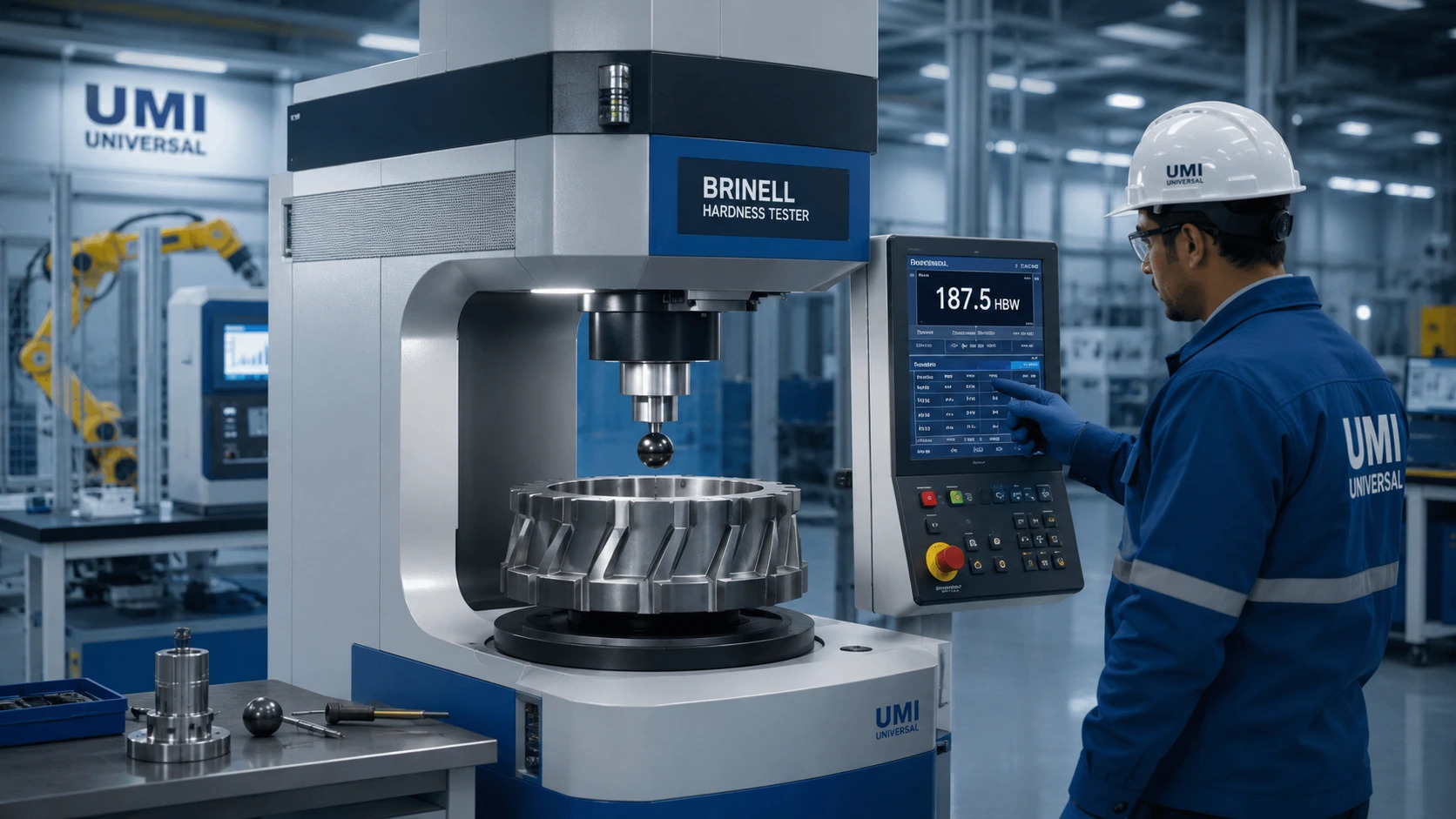
When Swedish engineer Johan August Brinell introduced his hardness testing method at the Paris World Exhibition in 1900, he couldn’t have imagined it would still be the gold standard for material quality control in the 21st century. Today, a Brinell Hardness Tester remains the preferred instrument in foundries, forging plants, steel mills, automotive manufacturing, and research laboratories worldwide.
Unlike Rockwell or Vickers tests, the Brinell method measures hardness over a relatively large surface area — making it exceptionally reliable for coarse-grained metals, castings, and forgings where micro-level testing would produce misleading results. Whether you are procuring equipment for a metallurgical lab, setting up a quality control station, or simply need to understand material behavior, this comprehensive guide covers everything you need to know about the Brinell Hardness Tester.
| UMI TIP | UMI Universal offers a full range of Brinell Hardness Testers for lab and industrial use, calibrated to ASTM E10 and ISO 6506 standards. Explore our product range at universal-motion.com. |
Competitor Analysis: How Top-Ranking Blogs Cover This Topic
Before building the definitive resource, here is a transparent look at what leading competitors cover — and where they fall short:
| Competitor | Strengths | Gaps We Fill |
| NextGen Material Testing (nextgentest.com) | 124-year history narrative, product links | No comparison tables, weak FAQ, no CTA for Indian market |
| Metkon (metkon.com) | Technical depth on metallography | No portable tester coverage, no buyer’s guide |
| King Tester (kingtester.com) | ASTM compliance focus, portable testers | No standards explained, no Brinell vs alternatives |
| UPI Laboratories (upi-laboratories.com) | Good HBW formula explanation | No industry-wise application breakdown |
| Innovatest Europe (innovatest-europe.com) | Load/ball combinations detail | No digital vs manual comparison, no FAQ schema |
| UMI Universal (universal-motion.com) | Indian manufacturer, full product range | THIS ARTICLE fills the content gap! |
This article is structured to outrank all of the above by covering every angle: working principle, types, standards, applications, buying guide, comparisons, FAQs, and a direct CTA.
1. What is a Brinell Hardness Tester?
A Brinell Hardness Tester is a precision instrument used to measure the resistance of a material to permanent indentation. It works by pressing a hardened tungsten carbide ball (typically 10 mm in diameter) into the surface of a test specimen under a specified load for a defined dwell time. The diameter of the resulting indentation is then measured and used to calculate the Brinell Hardness Number (BHN) — also formally expressed as HBW (Hardness Brinell Wolfram).
The Brinell Hardness Formula
The Brinell Hardness Number is calculated as follows:
HBW = (2F) / (πD × (D − √(D² − d²)))
Where:
- F = Applied test force in kgf
- D = Diameter of the ball indenter in mm (typically 10 mm)
- d = Diameter of the indentation in mm
| KEY FACT | The Brinell test is the oldest hardness testing method still in widespread industrial use, standardized under ASTM E10 (USA) and ISO 6506 (International). The ‘W’ in HBW stands for Wolfram — the German name for Tungsten, the material used in the carbide ball indenter. |
2. Working Principle of the Brinell Hardness Test
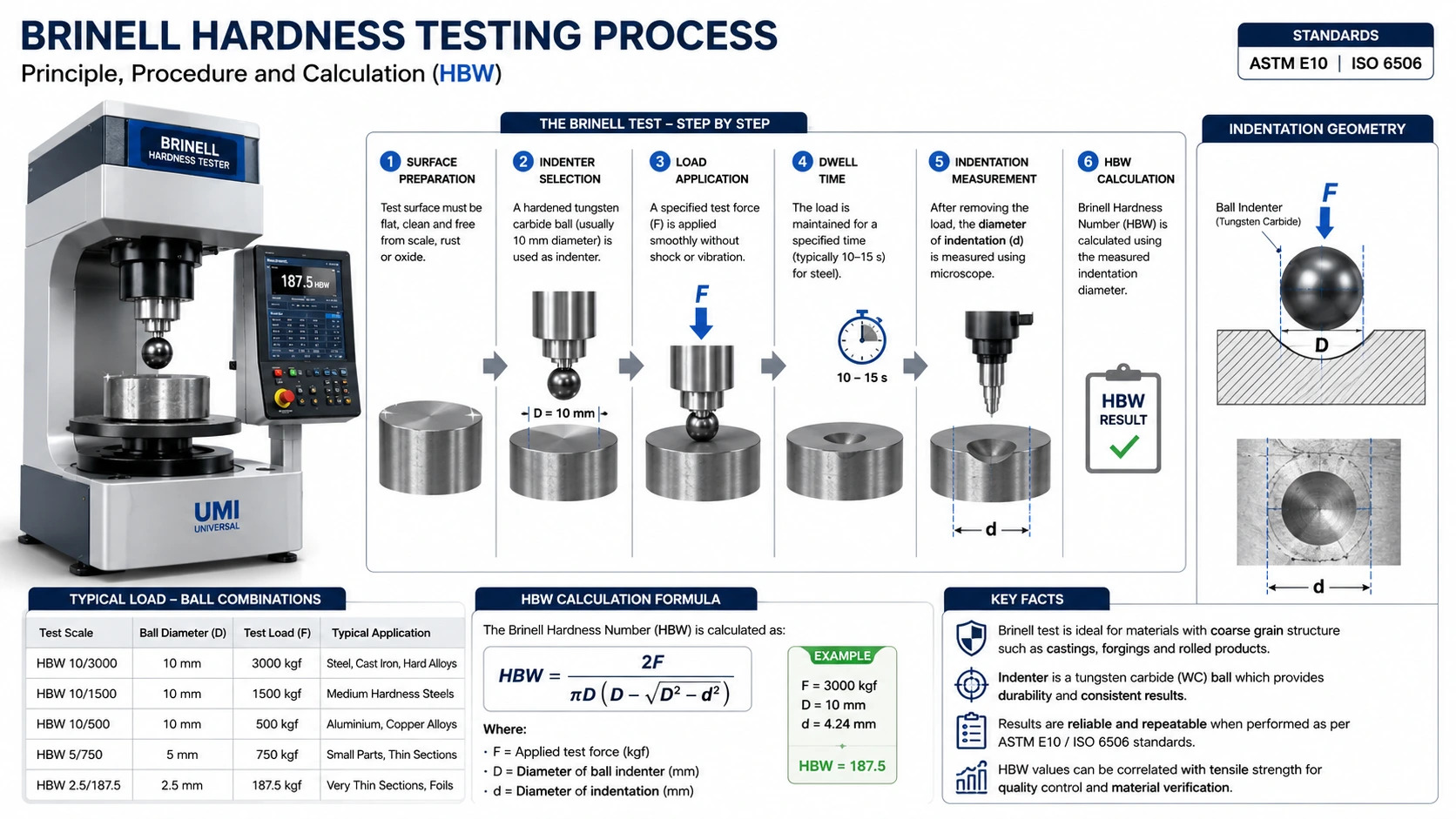
Understanding how a Brinell Hardness Tester works helps engineers make better choices about test parameters and equipment selection.
Step-by-Step Process
- Surface Preparation: The test surface must be flat, clean, and free of scale or oxide layers. Rough surfaces are lightly ground or filed.
- Indenter Selection: A 10 mm tungsten carbide ball is most common. Smaller balls (5 mm, 2.5 mm, 1 mm) are used for thin or small specimens.
- Load Application: The tester applies the specified load (ranging from 1 kgf to 3000 kgf) smoothly and without shock or vibration.
- Dwell Time: The load is maintained for a specified period — typically 10 to 15 seconds for steel, and 30 seconds for softer metals like aluminum.
- Indentation Measurement: After load removal, the diameter of the indentation is measured optically using a calibrated microscope or CCD camera (in digital models).
- HBW Calculation: The Brinell Hardness Number is calculated automatically (digital testers) or manually via lookup tables.
Standard Load-Ball Combinations (ASTM E10 / ISO 6506)
| Test Scale | Ball Dia (mm) | Load (kgf) | Typical Application |
| HBW 10/3000 | 10 | 3000 | Steel, cast iron, hard alloys |
| HBW 10/1500 | 10 | 1500 | Medium hardness steels |
| HBW 10/500 | 10 | 500 | Aluminium, copper alloys |
| HBW 5/750 | 5 | 750 | Small steel parts |
| HBW 2.5/187.5 | 2.5 | 187.5 | Thin sections, small samples |
3. Types of Brinell Hardness Testers
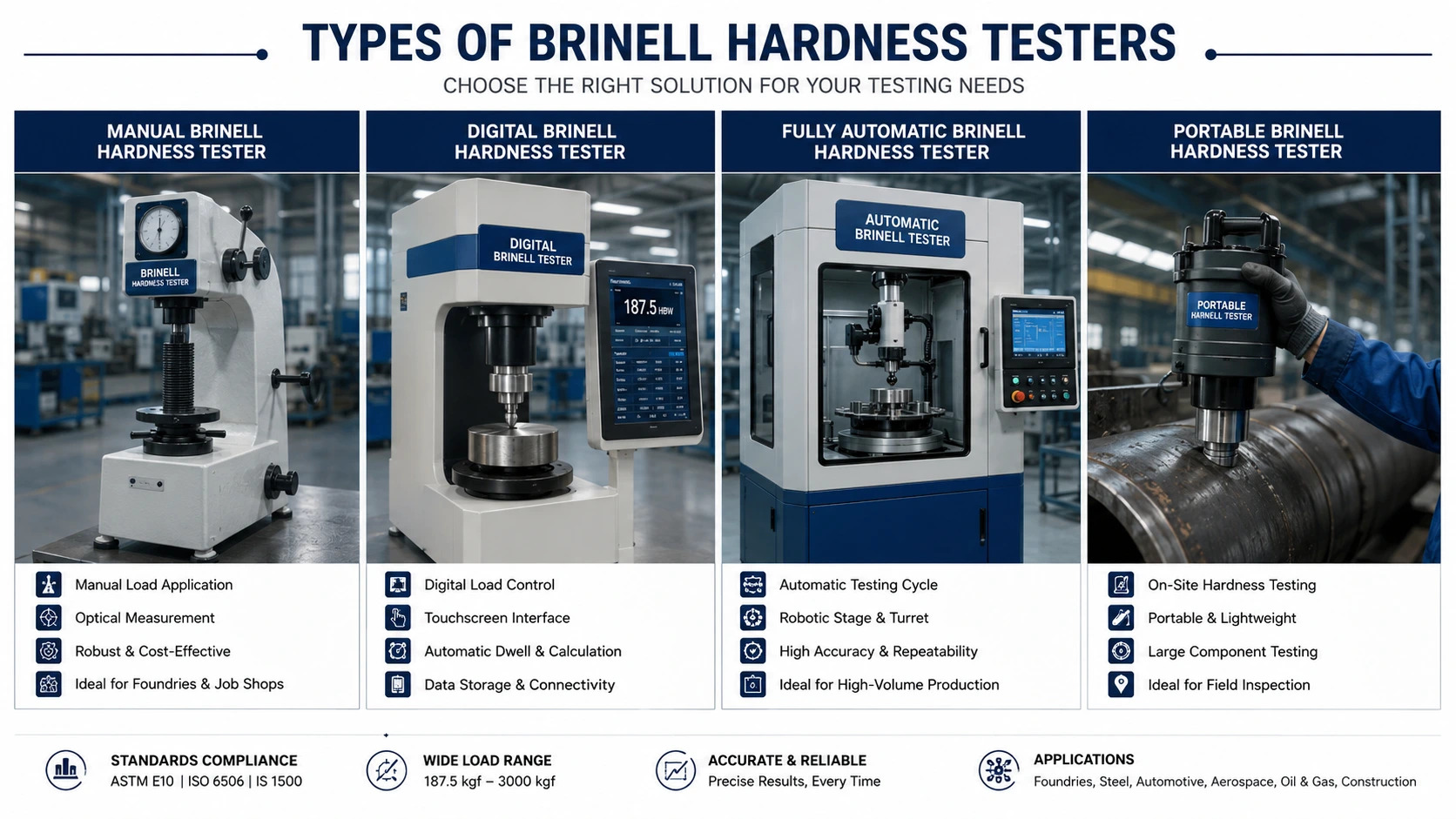
Modern Brinell Hardness Testers come in several configurations to meet different testing environments, volumes, and accuracy requirements.
3.1 Manual Brinell Hardness Tester
The traditional workhorse of the foundry floor. The operator manually loads the indenter, controls dwell time, and measures the indentation diameter using a portable optical microscope. Manual testers are robust, cost-effective, and highly portable.
- Best for: Field inspections, small foundries, low-volume testing
- Load range: 187.5 kgf to 3000 kgf
- Standard compliance: ASTM E10, ISO 6506
- Key advantage: No electricity required for basic models
3.2 Digital Brinell Hardness Tester
Digital models feature LCD or touchscreen displays with automatic load application and electronic force measurement. Many include USB/RS-232 data output for integration with quality management systems.
- Best for: Production QC labs, automotive suppliers, steel mills
- Key advantage: Eliminates human error in force application; data logging capability
- Look for: CE certification, load cell accuracy of ±1%, built-in calibration
3.3 Fully Automatic Brinell Hardness Tester
Top-of-the-line systems with motorized stages, CCD camera image analysis, automatic indentation measurement, and statistical reporting. These systems meet the most demanding laboratory and production environments.
- Best for: High-volume production lines, aerospace, automotive OEMs
- Features: Automatic turret, multiple test cycles, SPC software
- Standards: ASTM E10 Class A, ISO 6506-2
3.4 Portable Brinell Hardness Tester
Designed for in-situ testing of large workpieces — pipes, structural beams, heavy forgings — that cannot be brought to a lab. Uses hydraulic or mechanical loading with a handheld indenter fixture.
- Best for: On-site inspection of welds, large castings, pressure vessels
- Accuracy: ±1-3% with NIST-traceable calibration blocks
- Popular standard: ASTM E110 (portable Brinell testing)
4. Brinell vs Rockwell vs Vickers: Which Test is Right for You?
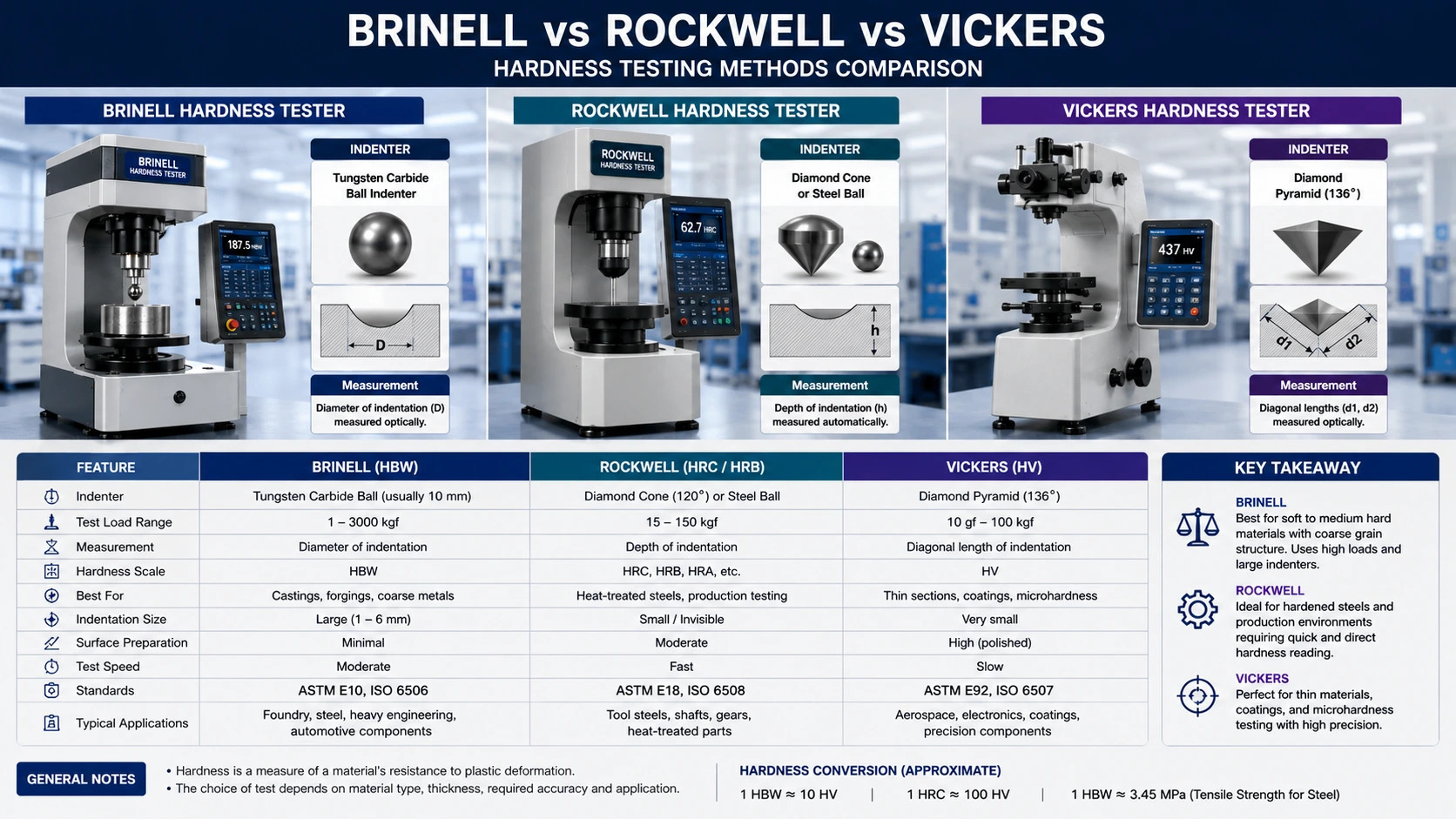
One of the most common questions engineers ask is how the Brinell test compares to other hardness testing methods. Here is a comprehensive side-by-side comparison:
| Parameter | Brinell (HBW) | Rockwell (HRC/HRB) | Vickers (HV) |
| Indenter | 10mm WC Ball | Diamond cone / steel ball | Diamond pyramid |
| Load range | 1 – 3000 kgf | 15 – 150 kgf | 10g – 100 kgf |
| Best for | Castings, forgings, coarse metals | Heat-treated steels | Thin coatings, microhardness |
| Surface prep | Minimal | Moderate | High (polished) |
| Indentation size | Large (1–6mm) | Invisible to small | Very small |
| Speed | Moderate (2–5 min) | Fast (30–60 sec) | Slow (setup-intensive) |
| Standards | ASTM E10, ISO 6506 | ASTM E18, ISO 6508 | ASTM E92, ISO 6507 |
| Typical industries | Foundry, forging, steel | Tool steel, automotive | Aerospace, electronics |
The Brinell test is unmatched for materials with heterogeneous grain structures — it averages hardness over a larger area, reducing the influence of local microstructural variations. This makes it the definitive choice for cast iron, aluminum alloys, and heavy forgings.
5. Industrial Applications of Brinell Hardness Testers
The Brinell Hardness Tester serves critical quality control and material verification roles across a wide range of industries:
Foundry & Casting Industry
The primary domain of Brinell testing. Castings and forgings have inherently non-uniform grain structures that make micro-hardness methods unreliable. Brinell testing gives a true representative hardness value for cast iron, ductile iron, steel castings, and aluminum die castings.
Automotive Manufacturing
Engine blocks, crankshafts, connecting rods, brake components, and axle housings all require Brinell hardness verification before assembly. Automated Brinell testers are integrated into production lines for 100% in-process inspection.
Steel & Metal Production
Steel mills use Brinell testing for incoming and outgoing quality control of billets, blooms, plates, and structural sections. The correlation between HBW values and tensile strength (approximately HBW × 3.45 MPa for steel) makes it a fast indirect strength verification tool.
Aerospace & Heavy Engineering
Aircraft structural components, landing gear parts, and turbine housings require certified hardness values under strict aerospace standards. Brinell testing provides the traceability and documentation required for AS9100 and NADCAP quality systems.
Pressure Vessels & Piping (Oil & Gas)
The ASME and API codes for pressure vessel fabrication and weld qualification specify Brinell hardness testing of base metals and weld zones. Portable Brinell testers are used extensively on pipeline sections and vessel shells.
Construction & Civil Engineering
Structural steel for bridges, buildings, and infrastructure is verified against hardness specifications using Brinell testing. UMI Universal supplies complete material testing solutions including universal testing machines and hardness testers for civil engineering laboratories.
6. Buyer’s Guide: How to Choose the Right Brinell Hardness Tester
Selecting the correct Brinell Hardness Tester requires evaluating several key factors. Use this structured framework to make an informed purchase:
Factor 1: Test Load Capacity
Determine the hardest material you will regularly test and ensure the tester’s maximum load exceeds your requirement. For steel and cast iron, 3000 kgf capacity is standard. For aluminum and softer alloys, 500–1500 kgf is sufficient.
Factor 2: Manual vs Digital vs Automatic
Manual testers are economical and portable but operator-dependent. Digital testers reduce human error and enable data logging. Automatic testers maximize throughput for high-volume labs but require higher investment. Assess your testing volume: fewer than 20 tests/day — manual is fine; more than 50 tests/day — digital or automatic pays off.
Factor 3: Optical Measurement System
Indentation diameter measurement is the critical accuracy step. Options include a manual eyepiece microscope (budget), digital measuring microscope (mid-range), and CCD/CMOS camera with automated image analysis software (premium). For ISO 6506-2 Class A compliance, camera-based systems are recommended.
Factor 4: Standards Compliance
Confirm the equipment meets your applicable standards: ASTM E10 for North American markets, ISO 6506 for international/EU markets, and JIS Z 2243 for Japanese supply chains. Ensure calibration certificates are traceable to national standards (NPL in India, NIST in USA, PTB in Germany).
Factor 5: Sample Size & Geometry
Consider the maximum workpiece height, weight, and throat depth your specimens will require. Bench-top testers typically accommodate specimens up to 250–300 mm height, while universal floor-standing models handle larger components.
Factor 6: After-Sales Support & Calibration
Hardness testers require periodic calibration with certified reference blocks. Choose a supplier that offers: on-site calibration services, spare parts availability, trained service engineers, and comprehensive warranty coverage. UMI Universal provides nationwide service support across India.
| Use Case | Recommended Type | Key Specification |
| Small foundry / job shop | Manual Brinell Tester | 3000 kgf, optical microscope, ASTM E10 |
| Automotive QC lab | Digital Brinell Tester | 3000 kgf, CCD camera, data logging, USB |
| Steel mill production line | Automatic Brinell Tester | Auto turret, SPC software, high cycle rate |
| Field / on-site inspection | Portable Brinell Tester | Hydraulic loading, NIST traceable blocks |
| R&D / university lab | Digital with multiple loads | Programmable loads, image analysis software |
7. Key Standards for Brinell Hardness Testing
Compliance with international standards is non-negotiable for quality-certified Brinell testing. Here are the most important standards you need to know:
- ASTM E10 — Standard Test Method for Brinell Hardness of Metallic Materials (USA)
- ISO 6506-1 — Brinell hardness test: Test method (International)
- ISO 6506-2 — Brinell hardness test: Verification and calibration of testing machines
- ISO 6506-3 — Brinell hardness test: Calibration of reference blocks
- ISO 6506-4 — Brinell hardness test: Table of hardness values
- JIS Z 2243 — Brinell Hardness Test (Japan)
- IS 1500 — Method for Brinell Hardness Test for Metallic Materials (India/BIS)
All UMI Universal Brinell Hardness Testers are manufactured to comply with IS 1500, ASTM E10, and ISO 6506, ensuring your test results are globally recognized and accepted.
8. Maintenance, Calibration & Verification of Brinell Hardness Testers
A well-maintained Brinell Hardness Tester delivers consistent, traceable results throughout its operational life. Follow these best practices:
Daily Checks
- Verify the indenter ball is free of cracks, flat spots, or deformation
- Confirm the anvil surface is clean and free of debris
- Check the load mechanism for smooth, shock-free operation
- Run at least one test on a certified reference block and verify the result
Periodic Calibration (per ISO 6506-2 / ASTM E10)
- Direct verification: Calibrate the applied force using a certified load cell (annually)
- Indirect verification: Test certified hardness reference blocks — minimum 3 readings per block
- Optical system verification: Check microscope magnification and scale accuracy
- Maintain calibration records with certificates traceable to national standards
Indenter Replacement
Tungsten carbide ball indenters are hardness-certified items and must be replaced when: the ball shows visible wear or deformation, consecutive test results on the same block show increased scatter, or calibration verification fails.
| SERVICE TIP | UMI Universal provides factory-calibrated hardness reference blocks and certified tungsten carbide ball indenters as consumables. Contact us for scheduled maintenance contracts that keep your Brinell tester compliant year-round. |
9. Frequently Asked Questions (FAQ)
These FAQs are structured for Google’s Featured Snippets and FAQ schema to maximize organic search visibility.
Q: What is the difference between BHN and HBW?
A: BHN (Brinell Hardness Number) is the older notation using steel ball indenters. HBW is the current ISO-standard notation, where W stands for Wolfram (tungsten), the material of the modern tungsten carbide ball indenter. ISO 6506 mandates HBW notation; however, BHN is still widely used in industry, especially in North America.
Q: What is the HBW scale range for common metals?
A: Typical HBW values: soft aluminum alloys (20–80 HBW), copper alloys (50–150 HBW), cast iron (150–300 HBW), annealed steel (100–200 HBW), hardened steel (200–600 HBW). The Brinell method is generally not used above 650 HBW, where Vickers or Rockwell testing is preferred.
Q: How is Brinell hardness related to tensile strength?
A: For carbon and alloy steels, tensile strength in MPa is approximately equal to HBW × 3.45. This correlation (codified in ASTM A370) allows rapid, non-destructive estimation of tensile strength from a Brinell test — extremely useful in incoming material inspection without performing a full tensile test.
Q: What load should I use for Brinell testing of aluminium?
A: For aluminium alloys, the recommended load is 500 kgf with a 10 mm ball (HBW 10/500) per ASTM E10 and ISO 6506. Softer pure aluminium may use 250 kgf (HBW 10/250). The load-to-ball-diameter-squared ratio (F/D²) should be maintained consistently for comparable results.
Q: What is the minimum thickness for Brinell hardness testing?
A: The ISO 6506 rule is that sample thickness must be at least 8 times the indentation depth to avoid an anvil effect (false high reading). As a practical guide, minimum thickness is approximately: 6 mm for 3000 kgf/10 mm ball on steel, 3 mm for 500 kgf/10 mm ball on aluminium.
Q: Can Brinell hardness testing be used on welds?
A: Yes. Brinell hardness testing is specified in ASME IX, AWS D1.1, and many pipeline codes for weld procedure qualification and production weld inspection. Portable Brinell testers are used directly on weld zones without cutting test specimens — the maximum hardness limit in weld zones (typically 250–350 HBW depending on material) verifies freedom from hydrogen cracking risk.
Q: What is the difference between a portable and a bench Brinell hardness tester?
A: A bench Brinell tester (stationary) is used in labs where specimens can be brought to the machine — it offers higher accuracy, lower operator variability, and full data logging. A portable Brinell tester is brought to the workpiece for in-situ testing of large parts like pipes, vessel shells, and structural beams. Portable testers sacrifice some accuracy (typically ±3% vs ±1% for bench) for versatility.
Q: How often should a Brinell hardness tester be calibrated?
A: Per ASTM E10 and ISO 6506-2: indirect verification (using certified reference blocks) should be performed at the start of each test session or after any machine adjustment. Direct verification (force calibration with a load cell) is required at least annually or after any significant repair. Calibration certificates must document traceability to national measurement standards.
10. Related Topics to Explore
If you found this guide useful, you may also want to explore these related topics available on the UMI Universal blog and product pages:
- Rockwell Hardness Tester — Ideal for heat-treated steels and production testing
- Vickers Hardness Tester — Microhardness testing for thin coatings and case-hardened layers
- Universal Testing Machine (UTM) — Tensile, compression, and bending tests for complete material characterization
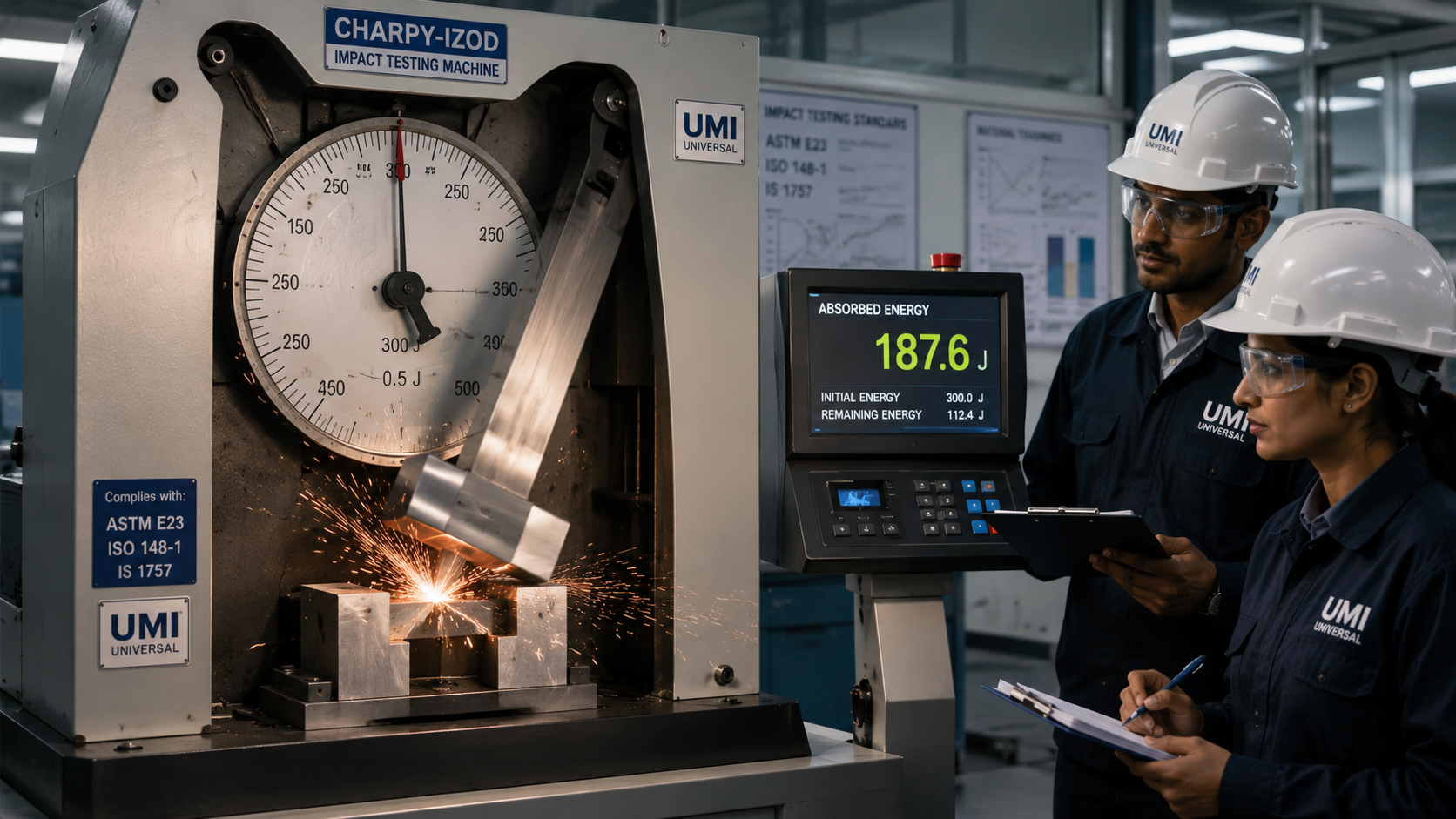
- Impact Testing Machine (Charpy & Izod) — Notch toughness testing for structural materials
- Hardness Conversion Table HBW to HRC to HV — Quick reference for cross-method comparisons
- ASTM E10 vs ISO 6506 — Key differences explained for lab managers
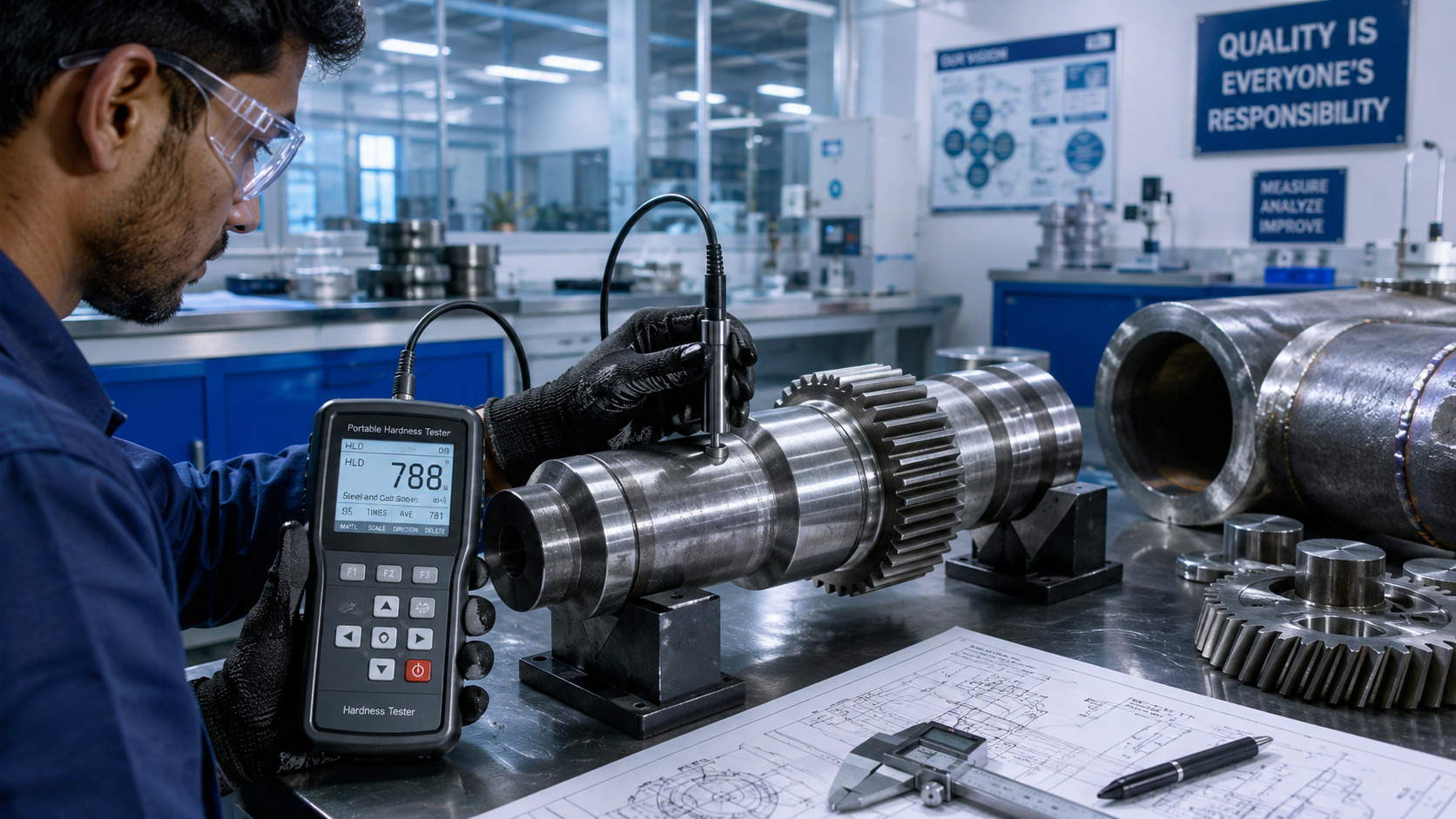
- Portable Hardness Tester Guide — Leeb, Ultrasonic, and Portable Brinell compared
Conclusion: The Brinell Hardness Tester — Your Partner in Material Quality
The Brinell Hardness Tester has stood the test of time for 125 years because it solves a fundamental engineering challenge: reliably measuring the hardness of real-world, imperfect materials — castings, forgings, weldments, and structural metals — that don’t lend themselves to microscopic testing methods.
Whether you need a robust manual tester for a small foundry, a digital system for an automotive QC lab, a fully automated platform for a steel mill, or a portable unit for field inspection, the key is matching equipment capabilities to your specific testing requirements.
UMI Universal (universal-motion.com) is a dedicated manufacturer of precision material testing equipment based in Pune, India. Our Brinell Hardness Testers are designed, manufactured, and calibrated to ASTM E10, ISO 6506, and IS 1500 standards — delivering accuracy, reliability, and long-term value for laboratories and production facilities across India and globally.
| Ready to Invest in a Brinell Hardness Tester? Get a free consultation, technical specifications, and competitive quote from UMI Universal — India’s trusted material testing equipment manufacturer. Contact Us: +91-2025204168 Visit: universal-motion.com Email us | Request a Demo | Download Product Catalogue |